

Let’s get this out of the way: FIFA is a corrupt organization, and it has been for a long time.
It often does things that are, at best, questionable and, at worst, filled to the brim with scandal. That’s just the way of the footballing world, and we’ve all, to some degree, come to accept it. Furthermore, Gianni Infantino’s tenure as FIFA president has been, to put it lightly, a mess. Ever wonder why Qatar and Saudi Arabia are hosting World Cups? Or why hydration breaks exist? Look no further than Infantino. He has shown time and time again that he’ll do just about anything to further his own interests alongside those he calls friends.
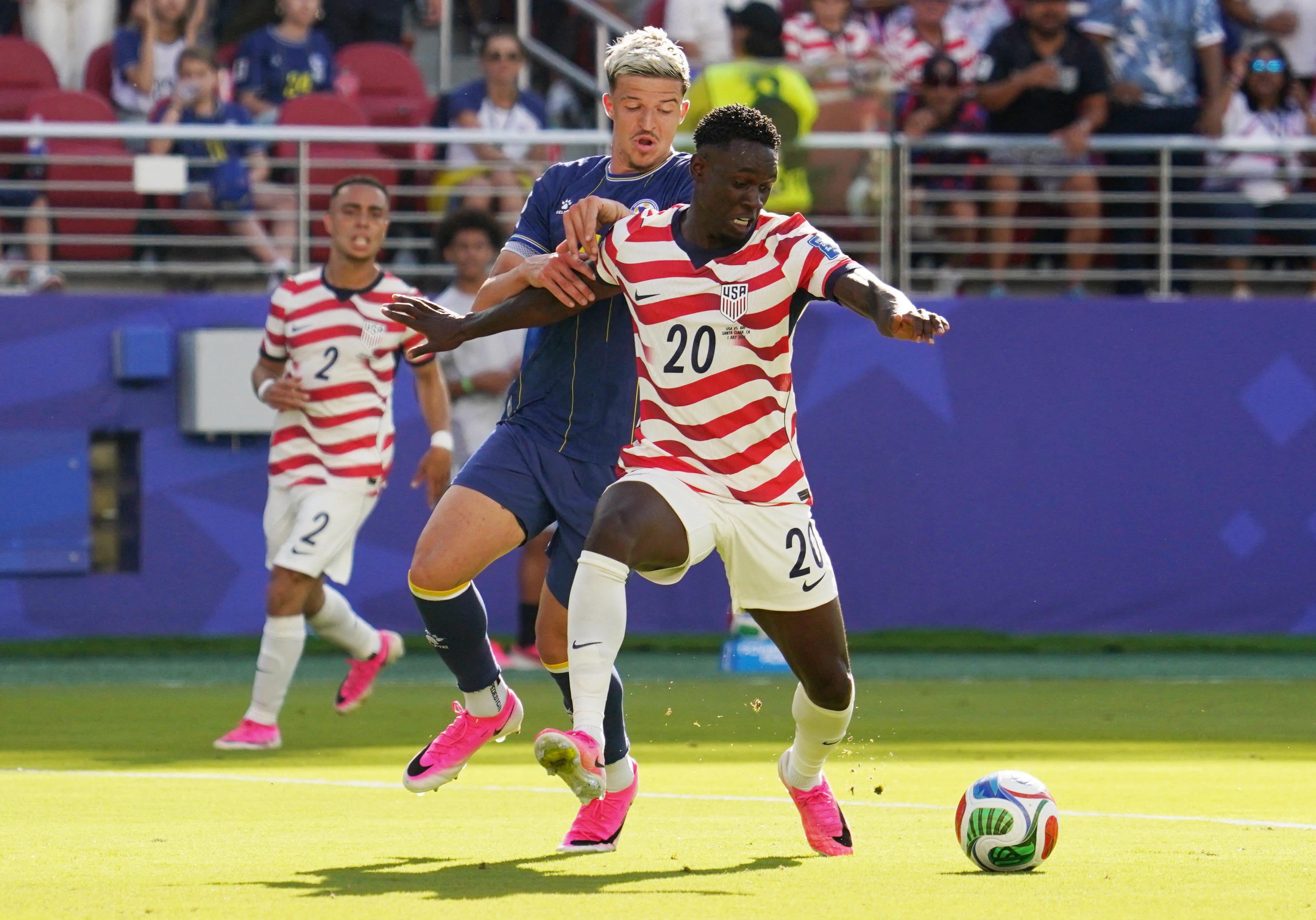
So, when FIFA inexplicably suspended Folarin Balogun’s automatic one-game suspension following his controversial red card in the United States’ 2-0 Round of 32 victory over Bosnia and Herzegovina, the public was right to raise its eyebrows.
This has happened only once before in World Cup history. Brazilian legend Garrincha was sent off in the 1962 World Cup semifinal against Chile but was ultimately allowed to play in the final, which Brazil won. That was more than six decades ago. It seemed like an awfully strange time for FIFA to dust off that precedent.
Let’s get another thing clear: Balogun’s foul against Bosnia and Herzegovina probably shouldn’t have been a red card in the first place.
The Video Assistant Referee (VAR), alongside the referee on the field, appeared to utilize slow-motion replay to determine that Balogun should be sent off. That is a violation of VAR’s own protocol. Slow motion is intended to help officials determine the point of contact on factual decisions, not the intensity of a challenge. For subjective decisions such as serious foul play, officials are instructed to evaluate the incident primarily at normal speed because slow motion can make challenges appear more deliberate and severe than they actually were in real time.
In other words, there is a legitimate argument that the process leading to Balogun’s red card was flawed from the beginning.
And then FIFA entered the arena.
FIFA’s Disciplinary Committee cited Article 27, which essentially gives the organization broad authority to suspend or modify disciplinary sanctions when it deems appropriate (aka whenever the heck it wants). The same article had already been invoked before the tournament to ensure that Cristiano Ronaldo would remain eligible for Portugal’s opening two group-stage matches.
Viewed strictly through that lens, FIFA ruling Balogun eligible again isn’t all that remarkable. Weird? Sure! But an outrage? Not really. There is at least some precedent through Ronaldo’s case, and the committee appears to have acted within the letter of its own regulations.
The problem isn’t necessarily that FIFA reached this conclusion. The problem is that FIFA never explained how it reached this conclusion.
To date, there has been no written or oral explanation as to why the Disciplinary Committee believed this specific suspension warranted intervention while countless others throughout World Cup history have not. If Article 27 exists for extraordinary circumstances, surely this qualifies as a situation that deserves an extraordinary explanation.
Instead, everyone has been left to endlessly speculate.
As a hardcore supporter of the USMNT, I think that’s flat-out fishy.
Add in the fact that the White House made a direct call to Infantino, and the waters become even muddier.
Let’s give everybody the benefit of the doubt here, though.
Let’s assume FIFA acted completely independently and that any outside pressure from political figures played no role whatsoever in determining Balogun’s eligibility. That’s entirely possible. If that’s what happened, then fine. But if that’s the case, why won’t FIFA simply tell us why Balogun’s case deserved this type of result? More importantly, why won’t it tell Belgium?
Belgium has every right to be upset about this decision. Imagine preparing for the biggest match of your tournament under the assumption that your opponent’s starting striker is suspended, only to learn 36 hours before kickoff that FIFA has reversed course. Whether Balogun deserved to miss the match isn’t really the point. Belgium deserved to know why the governing body suddenly decided that one of the most rigid disciplinary rules in the sport no longer applied.
That explanation has yet to come.
Instead, FIFA merely cited Article 27 and moved on, leaving everyone else to fill in the blanks. That’s an incredibly strange way to handle a decision of this magnitude. If there is a legitimate legal or procedural justification — and there very well may be — why not share it? Why not explain exactly what made this case different from the countless controversial red cards that have resulted in automatic suspensions over the decades?
Transparency benefits everyone here. It benefits the United States because it eliminates the whispers that FIFA bent the rules to help the tournament hosts. It benefits Belgium because it allows its players, coaches and supporters to understand why the decision was made, even if they ultimately disagree with it. More importantly, it benefits FIFA because the organization so desperately needs credibility whenever it exercises broad discretionary powers.
Instead, FIFA chose silence.
And it’s that silence that makes this feel so uncomfortable.
As a U.S. supporter, I’m thrilled Balogun gets to play against Belgium. I also happen to believe the original red card was incorrect. Those two things can both be true. But they don’t erase the fact that Belgium has every right to ask questions, and it has every right to expect answers from the organization running the world’s biggest sporting event.
Football has always operated with certain hard-and-fast rules, and an automatic one-match suspension after a red card has long been one of them. There have been controversial dismissals before. There have been players who missed massive matches because referees got it wrong. There have even been World Cups decided by officiating mistakes that were never corrected after the fact. Fair or unfair, that’s just sports sometimes.
That’s why this decision feels so unusual. It’s not that FIFA reached a result that many people agree with. It’s that it reached that result through a process it has almost never used before and then declined to explain why.
If FIFA believes it got this one right, then it should have no problem showing everyone how it reached that conclusion.
Unfortunately, it has allowed speculation to replace transparency.
Maybe there’s a perfectly reasonable explanation for all of this. I genuinely hope there is. Until FIFA decides to share it, though, the controversy isn’t going anywhere.
And honestly, that’s entirely its own doing.
Go, go USA.