

“Some might say we will find a brighter day.”
— Oasis, “Some Might Say”
Bournemouth’s European dreams aren’t hard to comprehend. This is a club that didn’t believe it could be anywhere close to these heights not all that long ago, mostly because there was very little reason to believe it could.
Bournemouth was a League Two side as recently as the 2009-10 season, having narrowly avoided dropping out of the Football League altogether the year before. The Cherries were promoted to League One that spring, spent three seasons there and found their way into the Championship by 2013. Two years later, Bournemouth was in the Premier League, completing a rise through English football that happened quickly enough that there probably wasn’t much time for anyone around the club to properly comprehend what was happening.
It has bounced between the top flight and second division since, though even that description makes Bournemouth’s recent history sound considerably more ordinary than it actually is. The club that once had to worry about its continued existence is currently expanding Vitality Stadium from just over 11,000 seats to more than 20,000, a project Bournemouth says will help secure its long-term success and sustainability. There is something fitting about that happening now, because the stadium itself has started to become one of the few remaining parts of Bournemouth that still looks like it belongs to the club it used to be.
Everything else has changed.
Bournemouth now operates like a fairly big deal on the European continent, and there are several reasons for that. The flood of money into the Premier League has lifted the entire country’s footballing infrastructure above much of the rest of Europe, meaning clubs that would traditionally be considered part of England’s middle class suddenly possess financial resources that would make historically significant teams elsewhere on the continent fairly jealous. Bournemouth has benefited enormously from that reality, but it has also done something important with the money: It has generally spent it well.
Last season was the culmination of all of that. Bournemouth finished sixth in the Premier League and qualified for the Europa League, turning something that would have sounded completely absurd 15 years ago into a fairly logical reward for becoming a very good football team.
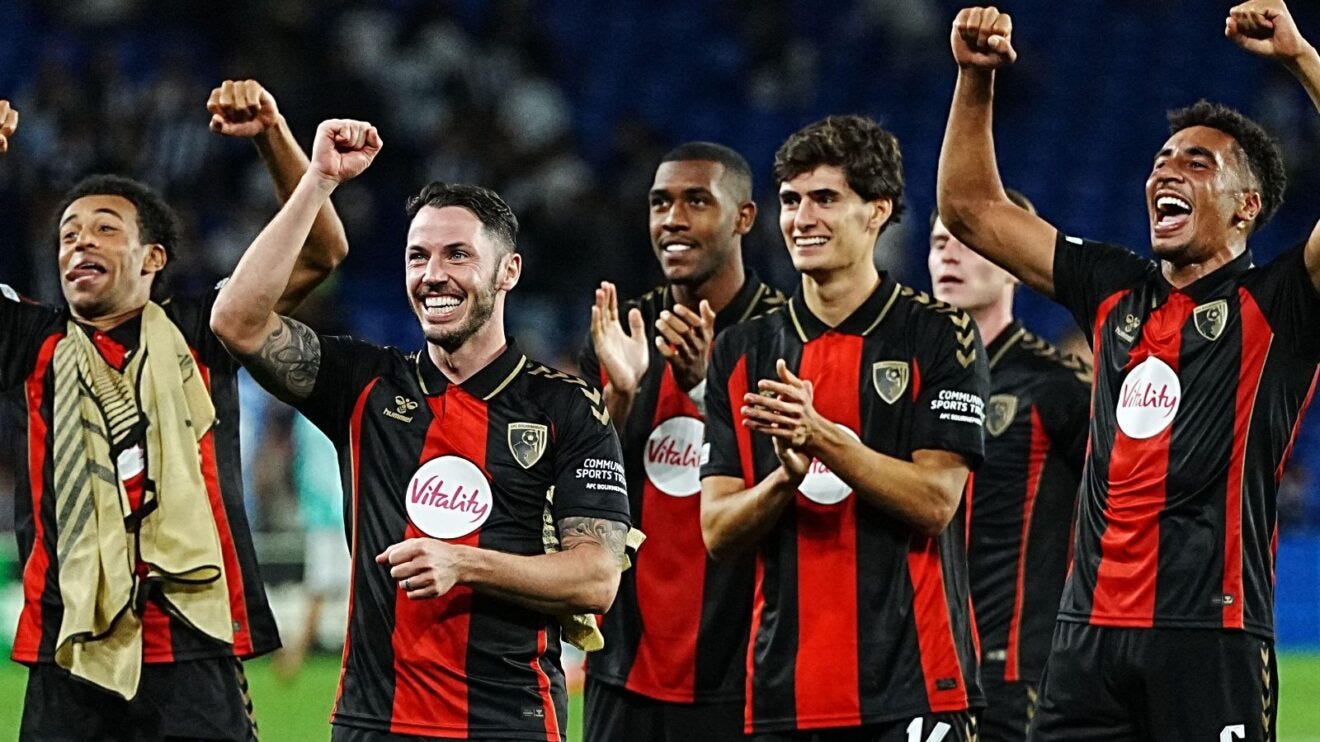
That distinction feels important, because Bournemouth did not stumble into Europe as some sort of happy accident. The Cherries earned their way here, and on Thursday night they traveled to San Sebastián and provided perhaps the clearest indication yet that simply qualifying for the competition was never going to be enough.
Bournemouth beat Real Sociedad 2-1.


The setting alone made the whole thing feel slightly surreal. Bournemouth had waited its entire existence for a European night and was immediately sent to one of the great football cities in Spain to play a club that has spent plenty of time in continental competition. There was no gentle introduction to any of this, and Bournemouth didn’t appear particularly interested in asking for one.
Justin Kluivert thought he had scored the first European goal in club history after 11 minutes, only for the flag to initially go up for offside before VAR eventually restored what would have been an especially cruel thing to take away. Nine minutes later, Alex Scott found Rayan, whose header made it 2-0 and left Bournemouth in the unusual position of having waited more than a century to play European football before requiring only 20 minutes to become quite good at it.
Real Sociedad eventually made the evening considerably less comfortable. Sergio Gómez pulled one back after halftime, and Bournemouth had to spend much of the second half protecting what it had built, with Djordje Petrovic making a couple of important saves late to preserve the victory. There was nothing particularly easy about the final half-hour, but that probably made the whole thing more appropriate anyway. Bournemouth had spent too long trying to get here for its first European victory to arrive without at least a little suffering.
I am somebody who loves to find the underdog in sports and then root for it to succeed, occasionally well beyond the point of reason. Bournemouth easily fits into that category, and watching it thrive in a competition that nobody 15 years ago would’ve thought it could even compete in is such a wonderful sight for somebody who remains a lifelong wishful thinker, at least when it comes to sports.
There were almost certainly Bournemouth supporters watching League Two football in 2009 who allowed themselves to imagine something like Thursday night. That is part of what being a sports fan requires, convincing yourself of outcomes that all available information suggests are ridiculous because the alternative is admitting there might be a ceiling on how far your club can go. Bournemouth kept raising that ceiling until eventually there wasn’t much of one left.
What’s even crazier to me is that Bournemouth is no longer merely an interesting underdog in this Europa League. According to Opta’s model entering the competition, it was the favorite to win the entire thing, with a 14.3% chance of lifting the trophy. Benfica was narrowly behind at 14%, with Bayer Leverkusen at 10.2% and Union Saint-Gilloise at 8.6%, while Sunderland, Juventus, Crystal Palace and AC Milan rounded out the other prominent contenders.
That list is somewhat baffling to me, particularly because Juventus and Milan don’t even crack the top five. These are two of the biggest clubs in the history of European football, organizations with trophy cabinets Bournemouth could only dream of matching, particularly considering the Cherries had never even played a European game before Thursday. And yet here they all are, playing in the same competition with a statistical model suggesting Bournemouth has a better chance of winning it than either Italian giant.
It’s hard for me to believe that neither Juventus nor Milan will have success in this tournament given the resources and talent available to them, but the fact Bournemouth can even reasonably be mentioned alongside them speaks volumes about how dramatically the balance of European football has shifted. Ten years ago, the idea that Bournemouth and Juventus could enter a European competition as something approaching competitive equals would have been unimaginable. Even now, after everything that has happened, it sounds somewhat ludicrous.
The Premier League’s enormous financial advantage is obviously responsible for plenty of that. Bournemouth is not alone here, because the clubs occupying England’s tier below the traditional giants now have access to players and resources that would once have been reserved for teams regularly playing in the Champions League. You can see the same thing with Sunderland and Crystal Palace, and all three entered this Europa League campaign with a legitimate argument that they could go deep into the competition.


England’s representatives certainly did little in Matchweek 1 to discourage that idea. Sunderland beat AZ Alkmaar 1-0 at the Stadium of Light in what was an incredible scene in its own right, while Crystal Palace cruised past Lech Poznan 4-0 in South London. Bournemouth’s victory was different, though, because it happened away from home against Real Sociedad and because there was so much history packed into the simple act of the Cherries being there in the first place.
There is obviously a long way to go before anybody in Bournemouth needs to start figuring out where exactly a Europa League trophy parade would fit in a town that is still working on doubling the capacity of its stadium. A 14.3% chance of winning something remains, inconveniently, an 85.7% chance of not winning it, and European competitions have a habit of dealing rather harshly with anyone who starts planning for May in September.
But winning the Europa League is almost beside the point right now. Bournemouth has spent the better part of the last two decades arriving at places that once seemed completely unreasonable, only for each new destination to eventually become normal. League One gave way to the Championship, the Championship gave way to the Premier League and simply surviving in the Premier League eventually gave way to competing near the top of it.
Now the Cherries are in Europe, too, and Thursday night provided the latest adjustment to what Bournemouth supporters are allowed to consider normal. The strange part is no longer that Bournemouth has made it this far.
It’s that nobody should be particularly surprised if it goes further.
Being new to English football, it is stories like this that draws me to this sport.