

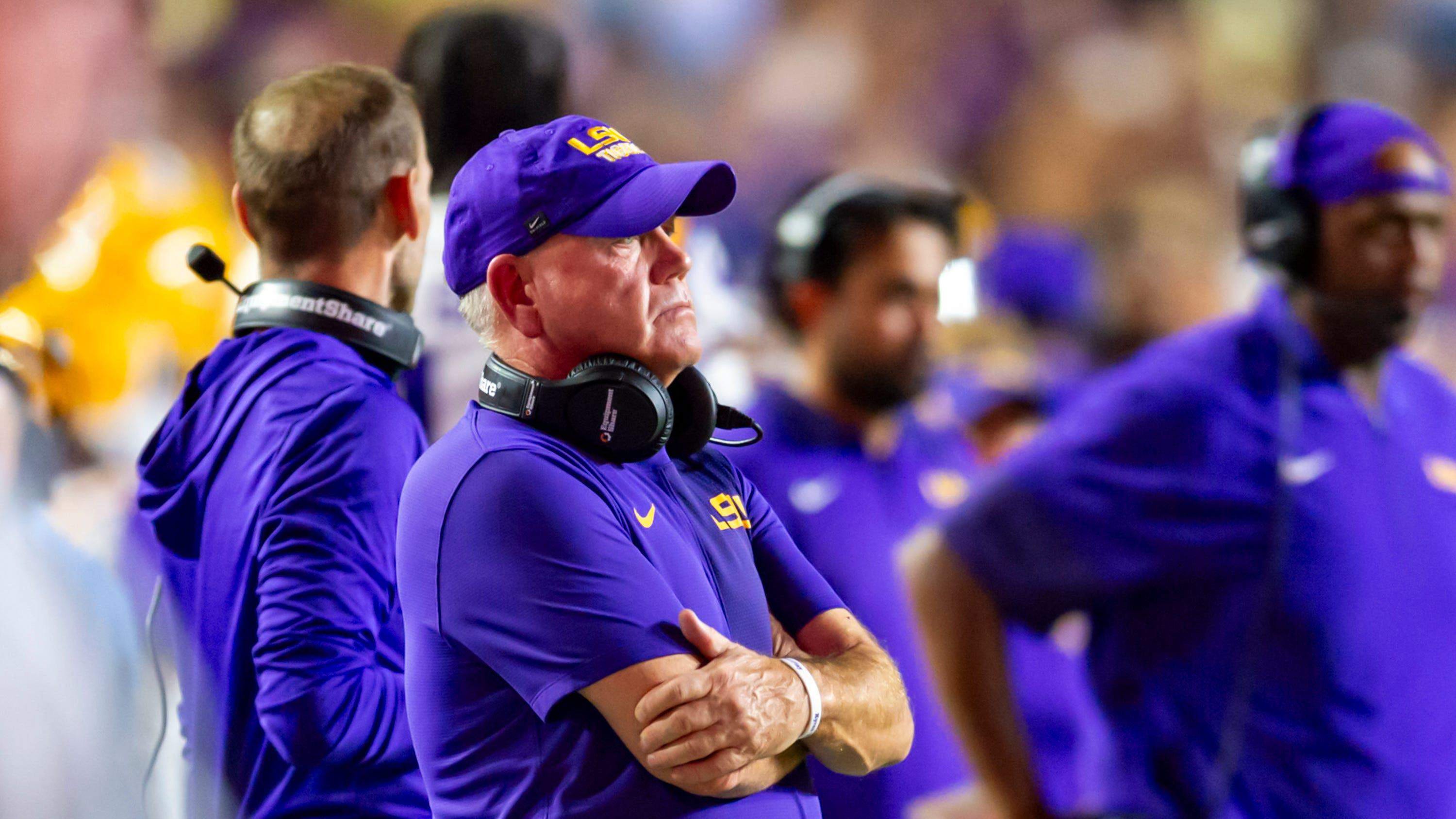
From the moment Brian Kelly was lured away from Notre Dame to Baton Rouge following the 2021 season, it always seemed like an odd fit.
Kelly, born and raised in New England, had never coached in the South. He didn’t sound like he belonged, although he sure tried during that fateful—and hilarious—halftime speech at an LSU basketball game. Sure, Kelly had won everywhere he had coached, from Grand Valley State all the way to Notre Dame, but there was a sense, at least from an outsider’s perspective, that LSU might not have been the best place for him to thrive.
What transpired over his three-plus years in Baton Rouge was among the most dysfunctional and disorganized stretches in LSU football history, and it all came to an end last night when the school announced that it was letting go of Kelly in order to pursue greener pastures.
One look at the wins and losses doesn’t necessarily indicate that it was an abject disaster, though anybody familiar with LSU knows it was a tire fire of the highest degree. When the going got tough during games, LSU players were frequently seen yelling, screaming, and even fighting each other on the sidelines. Kelly himself fed into these antics, particularly during Saturday night’s disaster against Texas A&M, by visibly chewing out his assistant coaches through his headset. And that was all indicative of much larger problems within the program as a whole.
According to Josh Pate, Kelly was absent during key moments in the offseason. When the recruiting cycle reached its peak and the transfer portal was at its most critical point, Kelly wasn’t in the trenches trying to land LSU the best players available—he was on a beach somewhere. While that wasn’t immediately clear to the general public, it could be inferred from the way he operated. He never seemed to run the program with LSU’s best interests at heart—he did it with his own in mind instead.
Yet none of that was Kelly’s greatest sin at LSU. What Kelly failed to realize once he got the job was that the most critical aspect of being the head coach at LSU was in the name. Louisiana’s high school football apparatus is engineered to generate players to compete at LSU. It’s a built-in recruiting base unlike any other in the country, and Kelly didn’t tap into it enough. In fact, he refused to do things the way previous Tigers head coaches had, which is his prerogative, of course, but he neglected his duty by foregoing the most important part of what makes LSU so special.
What resulted was a tenure that finished without a College Football Playoff appearance and, subsequently, without a national championship. The three head coaches prior to Kelly—Nick Saban, Les Miles, and Ed Orgeron—had all won national titles by their fourth year in Baton Rouge. In Kelly’s fourth season, he was fired.
This coaching carousel was already insane, as schools like Penn State, Florida, Arkansas, Oklahoma State, and many others had already moved on from their coaches. Now, with LSU open, the whole landscape has once again changed.
LSU is the best job available at the moment. There’s no ifs, ands, or buts about that fact. Some would say it’s the best job in college football, and while there might be some debate about that, there’s no quibbling that it’s at least top five alongside Alabama, Georgia, Ohio State, and Texas. You can order those however you please.
With that, LSU should have its pick of the litter for who it wants as its next head coach, with the most obvious name, Lane Kiffin, right at the top of the list. Hiring Kiffin does come with the important caveat that the school would probably have to pay him upwards of $13–14 million a year. Do the powers that be at LSU really want to do that after the disaster that was the Kelly contract? The correct answer would be no, but with Scott Woodward as the athletic director—the same man who hired Jimbo Fisher at Texas A&M—running the ship, there’s no telling which direction this coaching search could go.
Other names to look out for include just about anybody and everybody. You’d be surprised at how many coaches would leave their current position to become the head man at Louisiana State University. It’s a coveted role, and there are going to be plenty of suitors, some of whom might surprise you.
While it might be somewhat taboo to throw this out, given that Kelly was also the head coach at Notre Dame prior to coming to LSU, the Tigers have to give Marcus Freeman a call. Make him say no. And if you’re an LSU fan appalled by the prospect of rinsing and repeating with former Notre Dame head coaches, take comfort in the fact that Freeman is a polar opposite personality from Kelly. Sure, he’s not from the South, but neither was Saban, and he won a national championship in Baton Rouge. Freeman is a player’s coach, and after the fiasco that was Brian Kelly’s tenure, that players-first mentality would be much appreciated. But the same hurdles that apply to Kiffin apply to Freeman. It’s going to take a lot to swoon him away from Notre Dame, a place he’s led to the precipice of glory and could very well do so again in the near future.
Alternatively, LSU could go down to the lower levels of the sport and hire an up-and-comer to lead the program, like Tulane head coach Jon Sumrall. He’s won everywhere he’s coached, from Troy to now at Tulane. If LSU wants a coach who’s familiar with the South, will invest in Louisiana, and, most importantly, knows how to win, Sumrall is their guy. Unfortunately, it’s not necessarily flashy, which might prohibit the administration from pulling the trigger. But flashy doesn’t equal victory, and LSU should know that by now.
There’s a lot of turmoil within the university at the moment, as it’s still in the process of searching for a permanent president. That’s meant that the Board of Supervisors, as well as the governor of Louisiana, have had to step in and handle much of this business, which, of course, muddies the waters as to who is in charge. As everybody knows, the more cooks in the kitchen, the worse the process usually is.
In the end, where LSU turns for its next head coach is anybody’s guess. All we know is that winning a national championship is the standard in Baton Rouge, and if the next head man fails to meet that goal, he’ll face the same fate as Brian Kelly.