

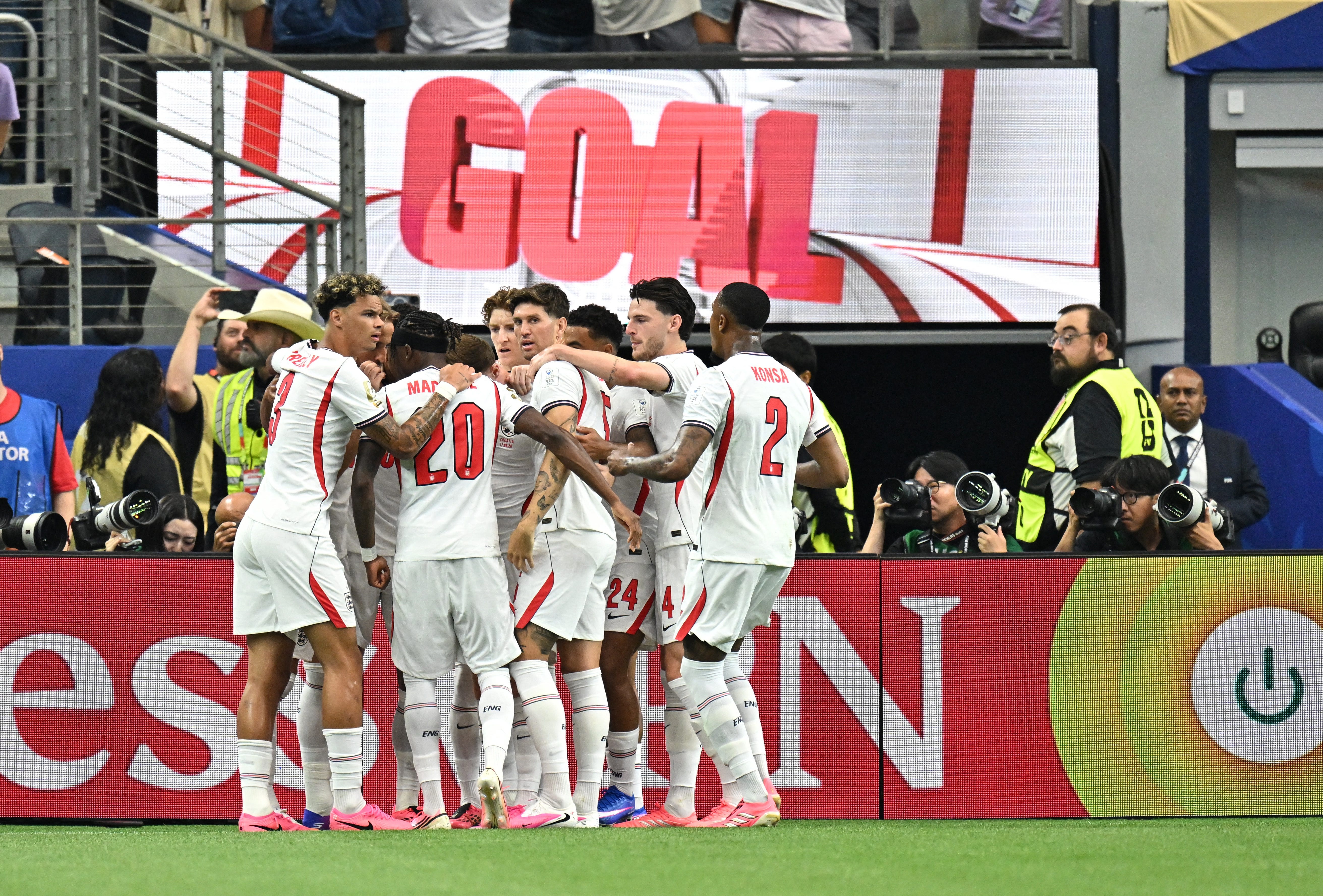
England fans have convinced themselves this is the year before. They did it with Rooney. They did it with Beckham. They did it with Gerrard and Lampard, and they certainly did it with Kane four years ago in Qatar. The names change — the hope doesn’t. Every summer brings with it the same impossible question: What if? What if the penalties finally go England’s way? What if the stars align? What if football actually — for the first time since 1966 — comes home?
I don’t know if the answer is yes. Frankly, I don’t think anybody does. England looked excellent against Croatia yesterday in a 4-2 victory at Jerry World and vulnerable during others. The defense certainly had its moments of uncertainty while the attack looked spectacular and as potent as ever. In other words, England looked like England.
And yet, something about this team feels lighter. Maybe it’s Thomas Tuchel, the new manager who’s brought a new approach to the whole operation. Maybe it’s Jude Bellingham’s emergence to superstardom. Maybe it’s Harry Kane smiling his way through the pressure instead of carrying it on his shoulders like he’s seemingly done every step of the way. Or maybe it’s just the simple reality that hope, no matter how many times it’s crushed, has a funny way of finding its footing again.
Either way, England — like all of us — is dreaming.
And if football actually comes home this summer — on American soil, no less — I fear the English may never stop talking about it. That would certainly be some endless banter.
Frankly, I don’t think the rest of us would ever recover.
England is so fascinating to me. This is the country that invented the modern game. The Premier League is the most watched domestic league on Earth. Its clubs are global institutions that have footholds in every nation, tribe and tongue. Manchester United, Liverpool and Arsenal have fanbases that span continents. Millions of people who have never stepped foot in England still rearrange their weekends to watch English soccer. The country breathes football in a way that’s similar to Americans’ love of college football. It’s a culture, identity and religion all wrapped up into one wonderful shepherd’s pie.
And yet, for all of that influence and prestige, England has won exactly one World Cup.
One.
It came in 1966. Geoff Hurst scored a hat trick against West Germany at Wembley Stadium. At the time, the Beatles were still together. Lyndon B. Johnson was president. No human had yet stepped foot on the moon’s surface. Heck, color television wasn’t even commonplace in most households around the world.
Since that wonderful moment of triumph, there’s been nothing.
That’s almost impossible to comprehend when you consider the players England has produced throughout the decades. Countless superstars have come and gone, and yet none of them have brought football back home.
That’s why every World Cup feels as heavy as a ton of bricks for England. Every match is more than just a simple match. Every group-stage stumble is treated like a national disaster. Every knockout victory is analyzed to death, while every knockout loss causes Parliament to declare that life is meaningless. Every manager is either a genius or an idiot — oftentimes an idiot. English fandom is, frankly, exhausting.
That’s why, despite my general distaste for all things English football (besides my beloved Spurs!), I found myself cracking a faint smile when Harry Kane scored his second goal against Croatia. That man is inevitable.
I know that’s not exactly groundbreaking analysis. Saying Harry Kane is good is like saying pizza tastes nice at the top of a ski slope or that the sun is hot in Texas on a July summer day. Everybody already knows. But every once in a while, Kane puts together a performance that reminds you not just that he’s great, but why he’s great.
His movement is absurd. He drifts into spaces defenders don’t anticipate. He drops deep to help build attacks. He can spray passes like a midfielder and then, seconds later, appear in the box to bury a chance with ruthless efficiency. England doesn’t simply have Kane — it revolves around him.
His first goal, which came on a penalty early in the first half, wasn’t the reason I got so hot and bothered. It was his second goal, a towering header off a corner from Declan Rice in the 42nd minute, that was just chef’s kiss. Perfect timing. Perfect placement. The type of goal that feels inevitable the moment the ball leaves the corner taker’s foot. Chef’s kiss, man. It was wonderful.
And with those two goals, Kane climbed higher into England’s World Cup history books.
Gary Lineker and Harry Kane: 10 goals.
Geoff Hurst: 5.
Bobby Charlton, Michael Owen and Marcus Rashford: 4.
That last name deserves some necessary attention.
Marcus Rashford has taken an unbelievable amount of criticism over the last several years. Some of it was deserved, while much of it wasn’t. Injuries, inconsistency and club turmoil transformed one of England’s brightest young stars into something of an afterthought. Not anymore — at least after yesterday afternoon’s game.
His goal against Croatia, which featured what I’d describe as a “finesse finish” that made me gasp in real time, was my favorite goal of the day. Why? Because it felt important. Rashford didn’t celebrate like a man proving people wrong. He celebrated like somebody finally taking a deep breath after holding it for years. And now his name sits alongside some of the greatest English footballers of all time. That’s pretty neat!
Of course, if Kane is England’s heartbeat and Rashford is a potential redemption story, then Jude Bellingham is the future. My goodness, this dude can play. I know everybody is keenly aware of his talents. That news is older than Dick Van Dyke. But there’s a difference between hearing about how talented Jude Bellingham is and actually sitting down to watch him for 90 minutes.
The way he maneuvers around the pitch is mesmerizing. One second he’s drifting between defenders, the next he’s charging toward goal like a runaway freight train. His goal against Croatia was a perfect example of this. There was no way I thought he was going to be able to score, but man oh man, did he. He took the ball and ran, and nobody from Croatia was going to stop him.
He’s smooth and violent all at the same time. Elegant chaos, if you will. There’s an arrogance to his game, and I mean that as the highest compliment imaginable. He expects to dominate every match he plays.
At 22 years old.
That, my friends, should terrify the rest of the world. It certainly does me.
Which is why I’m not particularly worried about England’s shaky defensive moments versus Croatia. Petar Musa’s goal — shoutout FC Dallas — wasn’t England’s finest moment, and there were stretches during the first half where Croatia found more space than head coach Thomas Tuchel would’ve liked. But the World Cup is weird. Teams evolve over the course of the tournament. Weaknesses can sometimes become strengths over time. Remember, Argentina lost to Saudi Arabia in 2022 and wound up lifting the trophy anyway.
In other words, one match — good or bad — doesn’t define a tournament. But it can definitely shape the way we feel about a team.
After watching England yesterday, I find myself believing a little more than I did before.
Which is dangerous.
Because hope has a funny way of finding its footing again.