

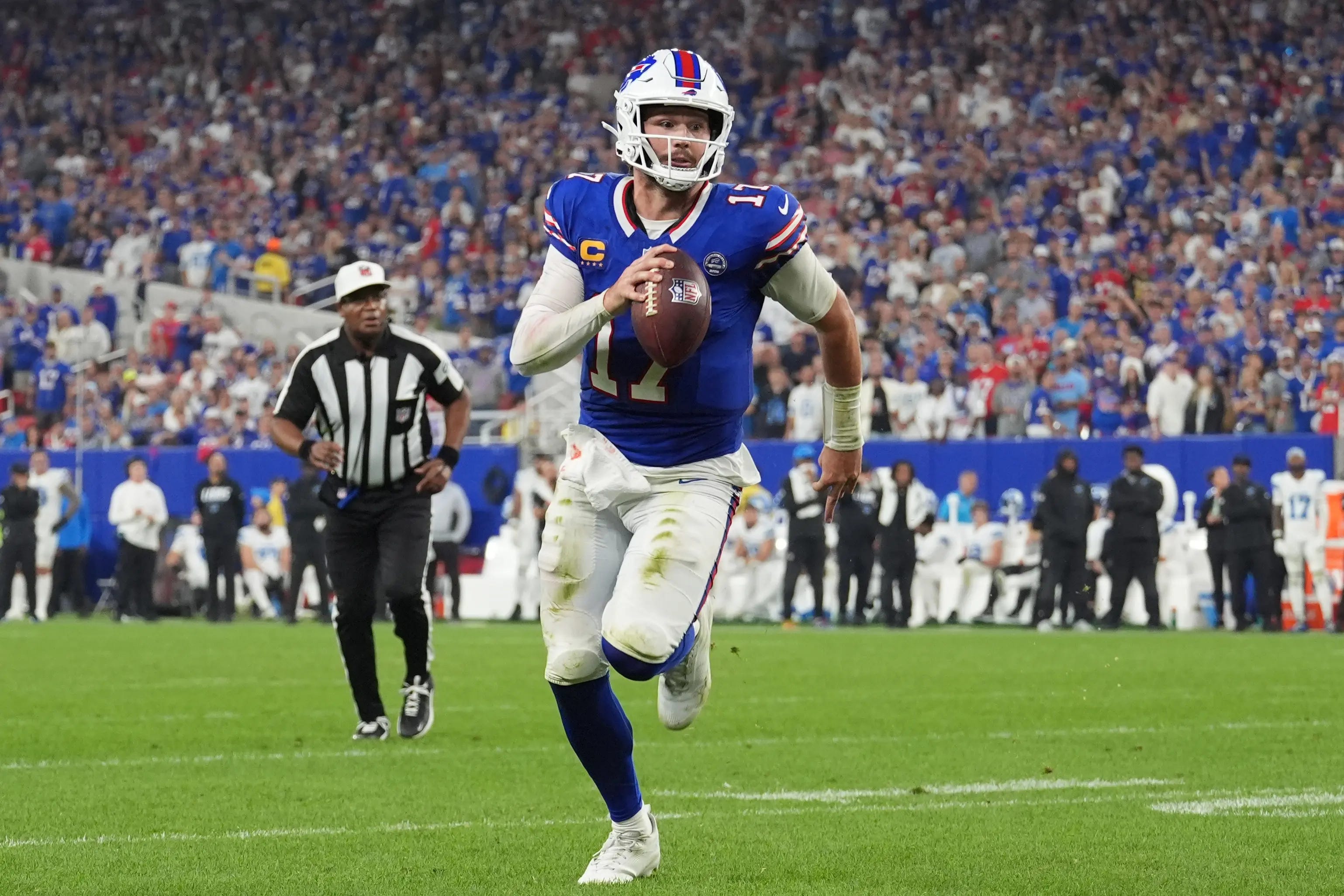
Just a couple hundred feet away from the Buffalo Bills’ new home lies the rubble of the old one, which feels almost a little too perfect.
Highmark Stadium opened Thursday night as a monument to what the Bills hope comes next, a shiny new building filled with all the modern amenities and general new-stadium smell that a couple billion dollars can buy. And then, right across the street, there is the place that contains almost everything Buffalo has spent the last half-century trying to outrun, slowly being reduced to concrete and twisted metal while the Bills start over again beside it.
The old stadium was where Bills fans learned, repeatedly and with almost comical thoroughness, that hope is a dangerous thing.
It started in 1973, and there were plenty of good memories mixed in with the bad. The Bills had some good seasons in the early-to-mid ’70s that ended in failure, while the latter years of that decade and much of the next were filled with so much despair that simply becoming relevant again would have qualified as progress. Then the hope returned in 1988, when Buffalo finally found its footing once more and began building toward something that felt considerably bigger.
That streak of excellence brought expectations, though, which ultimately strung along more sadness and despair alongside it. From 1990-93, the Bills made the Super Bowl four years in a row, first losing 20-19 to the New York Giants before falling to Washington the following season. Back-to-back failures against the Cowboys followed, completing what became known as the Four Falls of Buffalo and leaving behind a particularly cruel legacy: one of the greatest teams of its era, remembered as much for the four games it lost as all the ones it won.
Sports can be a little cruel like that.
In the years since the early ’90s, the Bills have desperately been looking for one more shot. A fifth chance to claim greatness. Season after season passed without it, and eventually Buffalo went from being the team that could not win the Super Bowl to being a team that would quite like to participate in the playoffs again. The 21st century was particularly unkind, as the Bills secured just one winning record over the first 13 years of the millennium.
It wasn’t until Josh Allen, and with him head coach Sean McDermott, arrived that hope sprung eternal again. Allen was originally a project when he was drafted out of Wyoming, the sort of quarterback prospect whose strengths were described in terms of what he might eventually become rather than what he already was. Then he became it, and suddenly Buffalo had the sort of quarterback every NFL team spends years searching for and most never actually find.
By the time the 2020s rolled around, the Bills were once again contenders for titles. This was wonderful news, except that being a contender meant Buffalo had once again exposed itself to the possibility of meaningful failure, and the Kansas City Chiefs were more than happy to provide it. Patrick Mahomes has become a recurring character in Bills history despite never actually playing for them, appearing every so often in January to remind Buffalo that having one of the best quarterbacks in the world is slightly less useful when somebody else has the other one.
Continuous playoff failure is almost worse than being an absolute failure. The bad years eventually become background noise; you complain about the team, watch anyway and get on with your Sunday. These Bills ask more of you. They spend four months making the Super Bowl feel plausible before requiring everyone to reckon with another season in which they were very good but not quite good enough.
Following 2025’s defeat in the AFC divisional round to the Denver Broncos, Buffalo decided it had finally seen enough of that particular arrangement. The Bills moved on from McDermott and pivoted by hiring then-offensive coordinator Joe Brady, Allen’s right-hand man. It was not a revolution so much as an adjustment, the sort of move a franchise makes when almost everything works and the fact that almost has become increasingly difficult to tolerate.
It was that pairing, the Bills hoped, that would lead Buffalo to the promised land.
A New Home and Another Reason to Believe
Which is how we arrived Thursday night, with the old stadium disappearing across the street and the new one filled for the first time with people who had decided, despite all available historical evidence, to believe again.
Buffalo entered on the heels of a 36-31 win over the vaunted Houston Texans, so there was already reason for some optimism. Detroit provided a useful second test because the Lions have their own Super Bowl aspirations and presumably did not travel to Western New York simply to admire the architecture. If this version of Buffalo really was different, or at least capable of being different, Thursday offered a decent opportunity to find out.
Here’s the Bills’ drive chart from Thursday night’s game, which probably just speaks for itself: touchdown, touchdown, touchdown, touchdown, punt, touchdown, punt, touchdown, end of game.
All of that came against a Detroit team that hopes to leave this season holding the Lombardi Trophy, and for much of the night, Buffalo made the whole thing look oddly uncomplicated. The Bills scored, gave the ball back, waited for Detroit to do whatever Detroit was going to do — usually nothing — and then went and scored again with what seemed like unlimited confidence.
It was impressive, to say the least.
But it was Allen’s efforts that really popped, which is a slightly ridiculous sentence to write about a quarterback whose efforts have been popping for the better part of six years.
The criticism of Allen has been rampant for years, though it is no longer really criticism of his ability. He has already settled that discussion. The question is whether all of the glorious regular-season success can eventually produce the postseason moment that Buffalo is still waiting for, because Allen does not yet have that marquee victory that ends with the Bills somewhere they have not been since the Four Falls.
Most of those problems have had to do with one team and one man in the Chiefs and Mahomes, although Denver was kind enough to diversify the heartbreak last season. That is not entirely Allen’s fault, of course, and reducing entire playoff losses to a quarterback’s personal record is one of the stranger habits football has developed. But quarterbacks receive an unreasonable amount of credit when everything works, so they tend to receive an unreasonable amount of responsibility when it doesn’t.
Yes, a 41-31 win over the Lions in September doesn’t change any of that. Far from it. There are still 15 more games for Buffalo to play this year, which is enough time for all of this hype and wonder to go down the drain several times over. We have been watching the NFL long enough to know that whatever appears undeniably true after Week 2 normally has a reasonable chance of looking hilarious by Thanksgiving.
Still, there is only so much skepticism you can reasonably maintain while watching the Bills score touchdowns on six possessions against a team that’s supposedly as good as Detroit could be this year.
The precision of Allen’s throws has been remarkable, but Buffalo also looks less reliant on him producing something preposterous every time the offense needs saving. James Cook can carry a substantial part of the operation out of the backfield, and Dalton Kincaid continues to grow into something more significant at tight end. That’s not to mention the steady stable of wide receivers Allen has at his disposal or Joe Brady, the man who entered into the unfamiliar role of head coach and appears to be passing the difficult test with flying colors.
All of that does not make them champions. It does not resolve anything about January, and it certainly does not guarantee that the latest attempt to get Allen to a Super Bowl will be any more successful than the previous ones. But there’s too much to like to completely dismiss these first two weeks as nothing but a mirage, because at some point skepticism becomes its own form of silliness.
The Bills are good. The Bills might even be great. This might be the year.
Let Hope Spring Eternal
Of course, it’s way too early to go about calling this the year, and anybody who has spent a meaningful amount of time caring about the Buffalo Bills knows how risky a proposition that truly is. The convenient thing about Thursday night was that nobody even needed to open a history book to remember why. They could simply walk outside, look a couple hundred feet away and see the old place being torn down.
Perhaps that is why the whole scene feels so appropriate. Buffalo has not escaped its history simply because it moved across the street, nor would Bills fans particularly want to; too much of what makes this team mean what it does is wrapped up in everything that happened over there. The losses matter because the hope mattered first.
And right now, hope is about as high as it has been in quite some time.
There will be plenty of opportunity for rationality later. January will arrive soon enough, bringing all the familiar anxiety with it, and Buffalo can worry then about Mahomes or Denver or whoever happens to be standing between it and that fifth Super Bowl appearance. Spending September preemptively worrying about how it might all end seems like an awfully miserable way to experience a team this fun and exciting.
So, as the old stadium is coming down and the new one is rocking, just let the Bills be.
Let hope spring eternal on the shores of Lake Erie.