

Major League Baseball has delivered a fantastic slate of Division Series matchups. From a McDonald's mascot becoming the face of Queens to the fighting Motor City Kitties, this past week of postseason baseball had it all, and more. But all that was eclipsed by the most important swing of a player's life. More on that later.
I started writing this post with the intention of covering all four Division Series matchups. As I dove into the Phillies-Mets series, I realized that those four games could be a whole post in and of itself, so that's what this update is.
Before I get into the recap, I'd like to respond to one of the biggest criticisms of the postseason format over the past several years. Yes, the teams that receive byes seemed to have a bit of a disadvantage. It's the whole "rest versus rust" argument that will plague the sports world forever. Everybody, including my American Cinema professor at school, seems to have an opinion. I am no different.
My simple answer to the people who say the postseason format is broken is that I agree, but not in the way most might think. I miss the days when all three division winners in each league received an automatic ticket to the Division Series. That, of course, is no longer the case, and the third-best division winners from the American and National Leagues–this year the Houston Astros and the Milwaukee Brewers–had to play in the best-of-three Wild Card round. Unfortunately for them (or maybe not so unfortunately in the Astros case), it resulted in them being ejected from the postseason by the Detroit Tigers and the Mets, respectively.
So, that's my only complaint about the format. I have no clue how to fix it because I do like the current best-of-three Wild Card rounds that we have. It's more baseball, and I'll always be a fan of more baseball. I just wish the division winners were rewarded more for their regular season efforts. Maybe there is no way to adjust, and we're stuck with this format. If that's the case, I think we could do much worse.
I'll add one more thing, this one courtesy of Jacob Rasch on Twitter (I'm not calling it X, it's a stupid name). In a series of tweets responding to complaints about the Philadelphia Phillies' early exit in the postseason, Rasch summarized my exact thoughts on why baseball is so amazing, and that it's just important to enjoy the ride. Here's one of his tweets that I think is amazing:
“The six months of baseball's daily grind you got to enjoy aren't invalidated by four bad games in October. Only one team gets to win the World Series every year, and if you view any season that doesn't end in one as a failure, you're gonna be miserable most of the time.”
Beautifully said, Jacob. Beautifully said. Everybody go give him a follow.
Alright, let's jump into what I believe is the most tantalizing NLDS we've had in a while.
As Kingpin from Spider-Man: Into the Spiderverse explains so eloquently in the video below, it's all about the Mets, baby.
The magic carpet ride the Mets are on right now is what makes sports so, well, magical. The Mets, who were forced to clinch a postseason berth in a double-header in Atlanta thanks to some terrible weather in the southeast, have ridden the wave of momentum to the NLCS. That momentum was built in part by an improbable 8-7 victory over the Atlanta Braves in game one of that aforementioned double-header that saw star Francisco Lindor hit a go-ahead two-run homer in the top of the ninth. I'll call that foreshadowing.
It was then on to Milwaukee, where the Mets had just played their final full regular season series, to play in the Wild Card round against the Brewers. New York took the first game 8-4. Milwaukee answered back with a comeback 5-3 win the next day to set up a win-or-go-home game three to decide who would take on the Philadelphia Phillies in the NLDS.
I'll try not to go into too much detail because this is a NLDS recap after all, but the Mets used some more of their magic in the Wild Card finale. Down 2-0 heading into the top of the ninth, thanks to back-to-back homers by Jake Bauers and Sal Frelick in the bottom of the seventh, the Mets were going to have to score at least two against Milwaukee's Devin Williams–a daunting task. Lindor led off the inning and worked an eight-pitch walk. Mark Vientos struck out, and Brandon Nimmo hit a sharp single to right field, putting runners at the corners with just one away. Who was coming up to the plate? Well, none other than the Polar Bear: Pete Alonso.
Side note: Alonso has not lived up to expectations in what is potentially his final season in a Mets uniform. He slashed .240/.329/.459 (.788 OPS) and hit 34 home runs, which on paper is pretty decent. But if you asked any Mets fan what they thought about Alonso, the response would probably be all negative. That pessimism was not alleviated by the fact that Alonso had embarrassingly dropped an easy foul ball pop-up in the bottom of the eighth.
Back to the top of the ninth. Williams started Alonso off with a changeup right down the middle. It's worth noting that Williams' changeup is his bread and butter. He throws it 45% of the time and in 2024, batters hit just .162 off it. He then threw three straight balls–two fastballs and a changeup–to go down 3-1. Not wanting to load the bases, Williams went back into the zone, this time with another changeup, but it caught too much of the plate. Alonso walloped it out to the opposite field to give the Mets a 3-2 lead. It was just the second home run that Williams let up all year. Those fans who were calling for Alonso's head were now singing his praises, and it was on to the NLDS for the folks from Queens.
If the Wild Card round wasn't enough, the Mets' four games against the Phillies should convince you that New York has some serious team-of-destiny vibes. Game 1 was going to be a daunting task for the Mets, given that the Phillies were starting Zach Wheeler, who turns it up to 100 when the calendar rolls around to October.
Wheeler was exceptional in Game 1. After the Phillies took an early 1-0 lead on a leadoff bomb by Kyle Schwarber, Wheeler cruised for seven innings, only allowing one hit while striking out nine. His team didn't give him any additional run support other than the Schwarber homer, however, so he handed the ball off to his bullpen with just that slim 1-0 advantage.
That's when the Mets entered chaos mode. New York scored five in the eighth inning off a trio of Phillies relievers (Jeff Hoffman, Matt Strahm, and Orion Kerkering). A Nimmo RBI single in the top of the ninth made it 6-1. Philadelphia added one more in the bottom half, but that was all it could muster, losing the opener 6-2. It was an absolute waste of a fantastic start by Wheeler, who has a 2.18 ERA over 70.1 innings of work in his postseason career. He always delivers when the lights get bright, but his team couldn't back him up this time.
On to Game 2. The Phillies were desperate, while the Mets were ready to pounce on their prey. New York scored two in the top of the third on a two-run homer by Vientos and added another in the top of the sixth when Alonso went yard. Then, Bryce Harper happened. Harper drilled a 98.6 MPH four-seam fastball in the heart of the plate off the green batter's eye 431 feet away for a two-run home run. One batter later, Nick Castellanos tied the game up with a monster blast to left. Game on.
What makes postseason baseball so fun is how games seem to always teeter-totter. It doesn't matter who's playing. Last Sunday night in South Philadelphia was no different. In the top of the seventh, Nimmo broke the tie with a solo homer of his own. A huge strikeout of Schwarber with two-on and two-out by Edwin Diaz in the bottom of the seventh preserved the Mets' slim lead, at least until the bottom of the eighth. After Trea Turner struck out to lead off the frame, Harper walked on four pitches. Castellanos got him to third with a line drive single to right, putting runners at the corners for Bryson Stott.
That's when Citizens Bank Park came unglued.
Stott tripled, scoring both runners. The Phillies led 5-4. Later in the same inning, J.T. Realmuto drove in Stott on a fielder's choice to increase that lead to 6-4.
But don't count out the Mets. Lindor singled with one away in the top of the ninth, bringing Vientos to the plate. Vientos, as you may recall, started the scoring for the Mets with his homer earlier in the game. Well, history repeated itself, as Vientos hit a ball, that was almost above his head, out of the park to tie the game.
Mets reliever Tylor Megill was able to get two quick outs to start the bottom of the ninth. He then walked Turner and Harper, bringing Castellanos to the dish. Castellanos, who had been booed earlier in the game by his own fans before hitting the solo home run, drove in the winning run on a single to left field. Phillies 7, Mets 6.
Game 3 was somewhat of a dud, but if you're a fan of Sean Manaea, it was a blast. Manaea was nails, pitching seven innings of one-run ball while striking out six and walking just two. He left the game with a solid 6-0 lead, which proved good enough as the Mets won 7-2. Alonso and Jesse Winker both went deep, and Jose Iglesias drove in two runs. All in all, a good day at the office for the Mets. For the fightin' Phils, who now faced elimination the next evening, it was a gloomy day.
If this Mets' postseason run results in a World Series title, then Game 4 of the NLDS will go down in history.
It started out as a standard, high stakes, postseason contest. Both pitching staffs were cruising for a good chunk of the early goings, with the only run being scored on an Alec Bohm fielder's choice in the top of the fourth.
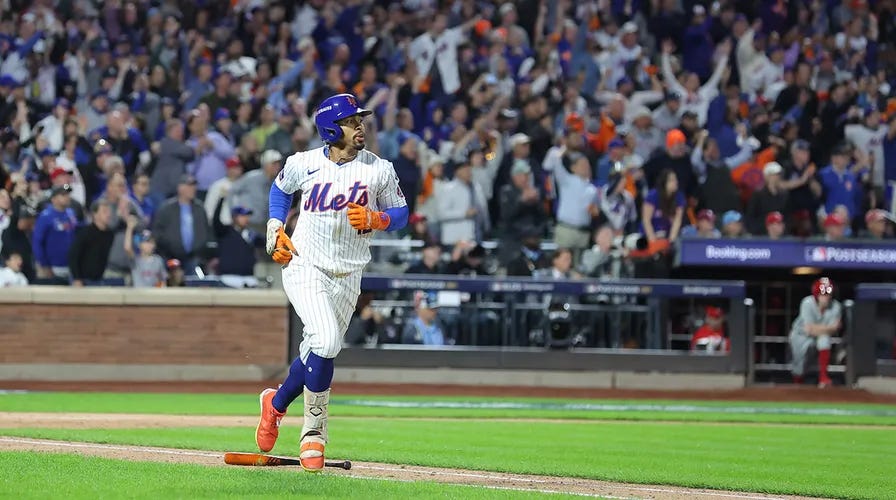
The Phillies took that slim 1-0 lead into the sixth inning, where everything unraveled. Jeff Hoffman had entered the game in the bottom of the fifth and had successfully extinguished a potential Mets rally by striking out Alonso and getting Iglesias to ground out. He stayed in for the bottom of the sixth, but what once looked easy in the fifth, now looked difficult. J.D. Martinez opened the frame with a single. A wild pitch then moved him to second. First base would end up being occupied anyway, as Hoffman then hit Starling Marte. Another wild pitch moved both runners up another 90 feet, before Hoffman walked Tyrone Taylor to load the bases. Hoffman was able to get Francisco Alvarez to ground into a harmless force out before Phillies manager Rob Thompson had seen enough. With Lindor coming up to bat and the bases loaded, Thompson wanted Carlos Estévez to be the one to pitch.
Estévez had been one of the Phillies' best high-leverage arms down the stretch. In 55 innings of work, Estévez had a 2.45 ERA and had only allowed five home runs. That was until he faced Francisco Lindor.
I'm going to let the video below do all the talking. Anything I have to say about this moment would not do it justice.
It's a superstar's job to not get overwhelmed by the moment. The second Lindor made contact with that ball, he had every right to throw his bat 100 feet in the air and scream like a banshee. But while everybody else screamed, clapped, and jumped, Lindor remained expressionless. He trotted around the bases like the grand slam he had just hit was a meaningless solo homer in a game in mid-June. It was anything but.
It's a moment that will live in the minds of Mets fans forever, especially if they can finish this run out and win the whole dang thing. It's a moment that has the potential to define a franchise, and maybe more importantly, define the player. Lindor is not without his spectacular moments in the postseason. His grand slam against the Yankees in Game 2 of the 2017 ALDS when he played for the Cleveland Indians comes to mind, but that was different. Cleveland ended up losing that series, and the moment has since faded into obscurity.
The 2024 slam will live for eternity. It's the type of swing that's put on Hall of Fame plaques. All the Mets have to do is finish the job.
This Mets-Phillies series will live with me for a long time, which is odd considering that it didn't even go the distance. Its individual moments were probably greater than the sum of the whole thing, but for me, that is enough. Lindor's slam was worth the price of admission alone.
We're now at the part of the recap where I should answer some lingering questions surrounding New York. Will the Mets advance to the World Series? Will they win the World Series? Which team is better: the 2015 Mets or the 2024 Mets? All those are valid questions but now is not the time. Those questions will be answered when the Mets start the NLCS in either Los Angeles or San Diego on Sunday evening. For now, I think we should all just sit in the greatness that was that moment, the moment that a city burst to life with baseball fervor. For 55 years, the Mets and their fans have been wandering through the wilderness, wondering if they'll ever find the pot of gold at the end of the rainbow again. Maybe the wait is finally coming to an end.