

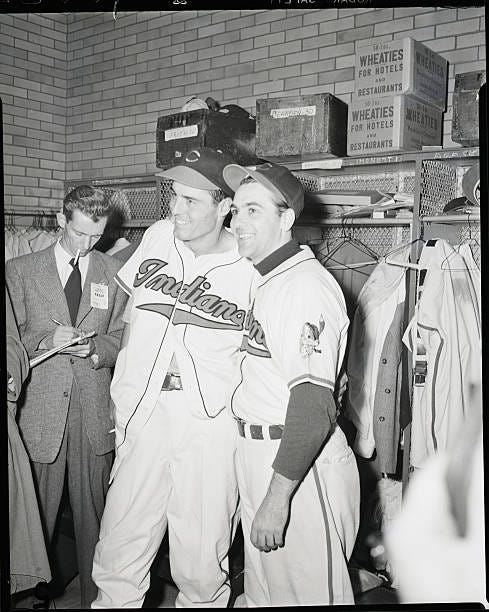
The Cleveland Guardians and the New York Mets, two teams with the longest World Series title droughts, were just eliminated from the postseason and will not have an opportunity to break their respective curses.
Cleveland hasn't won a championship since 1948, and the Mets haven't reached baseball's highest mountain since Bill Buckner let a ground ball go right through the wickets in 1986. It's been a long time.
As a fan of a team that didn't win its first World Series in franchise history until 2023, 51 years after the franchise had made its arrival in the Lone Star State, I know exactly what it feels like to crave the ultimate glory. Teams like the Yankees and the Cardinals are riddled with thrilling memories of championships gone by. Even if those moments of greatness happened over a generation ago, having hardware in the trophy case is still a luxury. The rest of us look on in envy, wondering what it's like to regularly soak in a champagne bath.
In hindsight, it was going to be difficult for either the Guardians or the Mets to triumph over the behemoths that the Yankees and Dodgers are. However, it was certainly still possible, which is what makes baseball great. But it didn't happen this time. The two passionate fan bases were left empty-handed once the final out of their seasons was recorded.
As the Dodgers and Yankees duke it out on the diamond this next week in what is certainly going to be a great World Series, I thought it would be entertaining to revisit the most recent championship for the team that's had to wait the longest to secure another piece of hardware once more. Many baseball fans, including me, might not be aware of how Cleveland won the 1948 World Series. That changes today. While I certainly can't capture the magic of anything written by a true fan of the Guardians or anything recorded about the series at the time, I can give you my perspective. Before each game of the 2024 World Series, I'll post a piece about that same game of the 1948 series.
Baseball's deep history resonates with so many. Baseball has been here forever. It's important to cherish all the memories we've had with it. I hope you'll walk with me as we learn about baseball’s storied history. It's going to be a lot of fun.
"The one constant through all the years, Ray, has been baseball. America has rolled by like an army of steamrollers. It's been erased like a blackboard, rebuilt, and erased again. But baseball has marked the time." - James Earl Jones, Field of Dreams
The first two games of the 1948 World Series were classics. One had ended in controversy because of an odd call by umpire Bill Stewart, and the other featured a fantastic pitching matchup between two Hall of Famers in Bob Lemon and Warren Spahn. On paper, Game 3 didn't have the same gravitas in terms of star-studded headliners, but it did have some entertaining baseball.
Both of those games had been close, and Game 3 was no different. All indicators pointed to it being a great day of baseball. The weather was perfect at just 63 degrees, and Cleveland Stadium was packed to the brim. The 70,306 in attendance were foaming at the mouth for a championship to return to Cleveland. They hoped that Game 3 would help propel them toward that goal.
Cleveland sent out rookie hurler and knuckleball specialist Gene Bearden to try and capture Game 3. If you recall, Bearden had been a pleasant surprise for Cleveland in 1948. His 2.43 ERA led the American League, propelling him to a second-place finish in the Rookie of the Year voting. His stellar performance in the win-or-go-home tiebreaker game against the Boston Red Sox was one of the reasons why the Indians found themselves in the World Series in the first place. Without Gene Bearden, Cleveland doesn't sniff the Fall Classic.
The Braves went with rookie Vernon Bickford to counter Bearden. Bickford was a Kentucky-born righty who'd started 22 games for Boston that season. Thanks to World War II, Bickford emerged into the majors at 27. He was an all-sport athlete; he played baseball, football, and basketball in high school. After he graduated, he played for a semi-pro team in Berwind, West Virginia. His performance there led him to be picked by the Class D Welch Miners where he struggled mightily. By the time he was drafted into the Army, he was ready to quit baseball altogether. It wasn't until he was stationed in the Philippines that he decided to pick up baseball again. From there the rest is history. Bickford's success in the minors following the war led him into the Braves starting rotation for the 1948 season. What never left him, however, was his lack of control. In 1948, he walked more batters (63) than he struck out (60). The Braves and Bickford certainly hoped he could find the strike zone against the Indians.
The stakes were high and with it the pressure. Several members of the 1920 Indians team that won the World Series were in attendance for the showdown, including Tris Speaker and Jack Graney. The stadium was filled to the brim and was roaring. Indians fans hadn't seen a World Series game since 1920 and were eager for the opportunity.
Both offenses were held in check in the early innings. Bearden and Bickford worked quick first innings. Bickford did walk Larry Doby in the bottom of the first, but he got Lou Boudreau to ground into an inning-ending double play. A scoreless second inning set the stage for the third, where everything started to go awry for Boston.
The inning started well enough for the Braves. Eddie Stanky led off the inning with a line-drive single to right field. A sacrifice bunt by Bickford enabled Stanky to advance an extra 90 feet and into scoring position with just one out. Bearden was not phased. Tommy Holmes grounded out on the first pitch and Al Dark lined out to deep right field, ending the inning and bringing the Indians up to the plate with an opportunity to take the lead.
Bickford got Jim Hegan, the first batter of the inning, to pop out, bringing his opposing pitcher, Bearden, to the plate. Bearden wasn't a terrible hitter for a pitcher; he had a .256 batting average with two home runs in 1948. Still, it was expected that Bickford would be able to take care of Bearden and get the second out of the inning. He did not. Bearden doubled to right field, putting a runner in scoring position for Cleveland. It was the same scenario that Boston's offense faced in the previous half-inning. Unlike the Braves, Cleveland was able to cash in.
The top of the order was next for Cleveland. Dale Mitchell walked, meaning it was Doby's turn to try and make another big play in this World Series. On the second pitch of the at-bat, Doby hit a sharp grounder to second, which could've been a disaster for Cleveland because it was a routine double play ball.
But Boston screwed it up.
Second baseman Eddie Stanky fielded it cleanly and tossed it to Al Dark, who then overthrew first on the relay throw. The ball went into the Cleveland dugout, prompting Bearden to come around to score. In a sport like baseball where games are often won on the margins, a mistake like that proved detrimental to Boston.
Bearden continued to cruise. He put down the side in order in the top of the fourth. His teammates provided him with some extra legroom with an additional run in the bottom of that same inning via a Jim Hegan RBI single. Ultimately, Bearden didn't need it. He didn't allow a run and pitched a complete game. The Braves made it easy on him, too. They swung early and often, which allowed Bearden to not use as much stamina. To complete nine innings, he only needed 85 pitches.
As I mentioned earlier, Bickford's command, or lack thereof, could've been a deterrent towards Boston picking up a Game 3 win. While he walked five batters in just 3.1 innings of work, it wasn't the reason Boston lost. Bickford pitched well enough to win. If it weren't for the error by Dark in the third inning, Bickford would've got out of the inning and most likely only allowed the one run in the fourth. The Braves' offense was horrible. Yes, Bearden was incredible, but the Boston offense refused to be patient against the knuckleball. It was a missed opportunity from the Braves, one they'd wish they'd been able to take advantage of in the coming days.
The 2-0 win in Game 3 gave the Indians a 2-1 series lead. A victory in Game 4 for Cleveland would all but end Boston's hopes of winning a title and start the Indians down the glorious journey to paradise.
Keep your eyes peeled for the Game 4 recap soon. Tomorrow's a busy day for me so I'll try to get it out by then, but if not, it'll definitely hit your inbox on Wednesday. Thanks so much for reading. You don't know how much it means.