

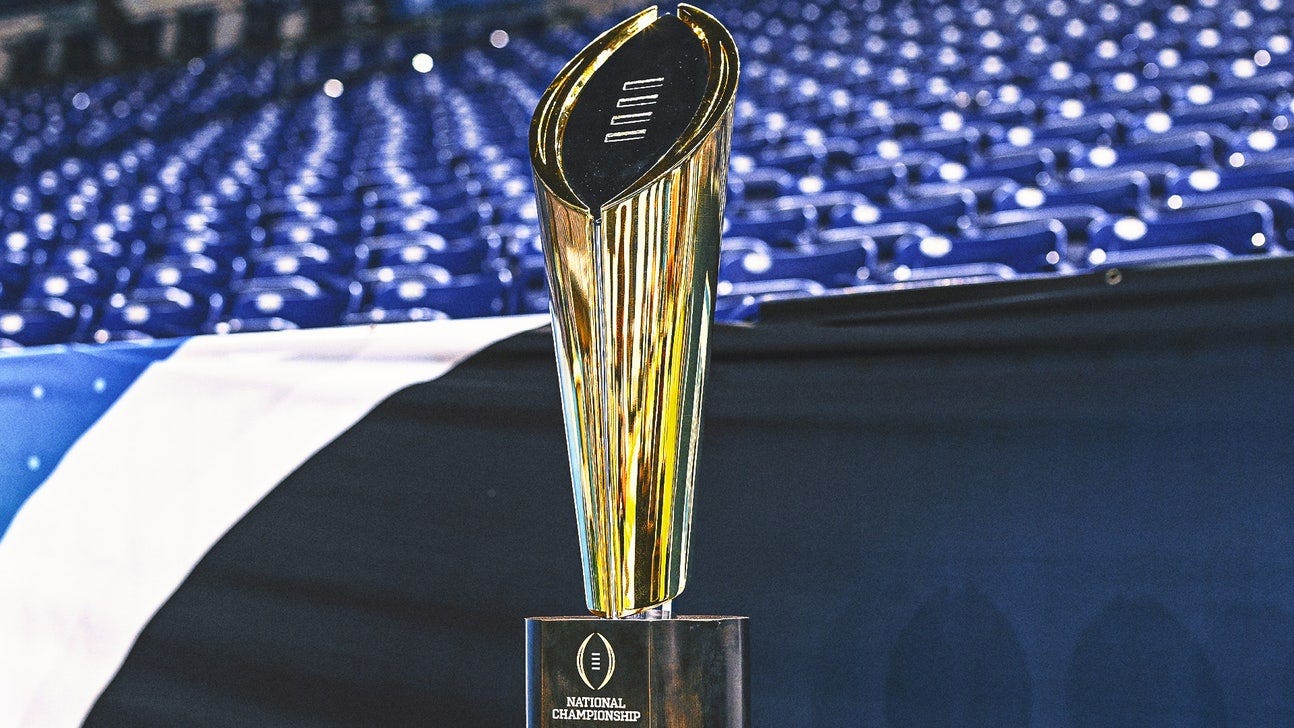
The 24-team College Football Playoff is not only an affront to almost everything college football has traditionally been, but also an astonishingly incompetent concept dreamed up by the same group of people whose résumés would suggest they have the sport’s best interests somewhere near the top of their priority list. Instead, we have reached the Dr. Ian Malcolm portion of college football administration, where everyone has become so preoccupied with whether they could that apparently nobody stopped to ask whether they should.
The people making these decisions seem convinced that every structural problem in college football can be solved by adding more inventory and more access. At some point, there has to be a limit to how much you can stretch the sport before it stops resembling the version people fell in love with in the first place.
There is a fairly simple way to explain why this bothers me so much. When college football expanded its postseason from two teams to four more than a decade ago, the idea was broadly popular, and I was among the people who wanted it. The BCS had produced some extraordinary seasons, but there was also a reasonable argument that limiting the national championship conversation to two teams was too restrictive for a sport as large and chaotic as college football.
A decade later, the playoff expanded again, this time from four teams to 12, and once again there was a logical argument behind the change. The sport had evolved, talent had become more mobile and the concentration of power that once made Alabama, Clemson, Ohio State and Georgia feel almost inevitable had started to loosen. There were simply more programs capable of competing at the top than there had been during the most dynastic years of the four-team era.
For the most part, the 12-team playoff has worked. There have been bad games because there are bad games in every postseason ever invented, and there have been a few moments where the regular season has felt slightly less urgent because a loss that once would have been fatal is now merely inconvenient. Still, none of that has been enough to ruin the experience.
Saturdays are still Saturdays. Campuses still transform every weekend, rivalries still make rational people behave like lunatics and a loss in October can still change the entire direction of a season. The sport changed without completely losing itself, which is about as much as you can ask from any major structural reform.
Apparently, that was not enough. Only a few years into the 12-team era, the people running the College Football Playoff are already seriously discussing a 24-team format that could begin as soon as 2027. We have not even had time to get used to the system we just adopted before the people in charge decided it needed to be torn apart again.
There has been no long period of stagnation here. There is no obvious competitive crisis demanding a solution, and there has certainly been no overwhelming call from fans begging for the field to double in size. The administrators in charge have simply looked at something that is mostly working and decided the proper response is more.
I will not pretend to speak for every college football fan in America, but nearly every conversation I have had about a 24-team playoff has ranged somewhere between reluctant acceptance and complete disgust. Even the people who are not furious about it tend to begin their defense with some variation of, “Well, I guess…”
Nobody is leaping out of their chair begging for the No. 21 team in the country to get one more shot at the national championship. Nobody watched the first two years of the 12-team format and came away thinking the obvious flaw was that another dozen teams had been left home. That is part of what makes this feel so different from previous rounds of expansion.
The move to four solved a problem that was easy to explain, while the move to 12 responded to a sport that had grown broader and more competitive. The argument for 24 feels backward, as if the expansion came first and the justification is now being built around it. The people in charge already seem to know they want more teams and more games, and now the rest of us are being asked to nod along while they tell us why it was necessary.
A handful of years ago, European soccer went through its own version of this exercise. In 2021, 12 of the continent’s biggest clubs announced plans to create the European Super League, an idea sold as a chance for the greatest teams in the world to play one another more often. On paper, you could almost understand the appeal.
Then everyone looked beneath the wrapping paper and found the same thing they always find in these situations: money and power. The backlash was immediate and overwhelming, with supporters protesting outside stadiums and flooding club channels with enough anger to make every social media manager involved question their career choices. Within days, the English clubs began pulling out and most of the project collapsed behind them.
The most important part of that story is that the fans won. What had been introduced as the future of European soccer disappeared before anyone had time to memorize the branding, and the people trying to force it through learned a basic lesson about sports. You can own the teams and sell the rights, but none of it means much if the people who care enough to watch decide they have had enough.
College football has had smaller versions of the same phenomenon. Tennessee fans revolted against the hiring of Greg Schiano, while Texas A&M supporters helped derail the possibility of Mark Stoops becoming their head coach. Reasonable people can argue about whether those uprisings ultimately improved either program, but the larger point remains the same.
Fans made enough noise that powerful people changed course. They had a voice, and more importantly, they believed using it could actually matter. I am not convinced college football fans feel that way anymore.
There will probably not be thousands of people protesting outside the College Football Playoff offices in North Texas. Nobody is likely to storm the SEC headquarters or surround the Big Ten offices demanding that the 24-team proposal be scrapped. American sports fandom does not really operate that way, and after years of realignment and constant structural change, I think a lot of people are simply exhausted.
That may be the most depressing part of this entire thing. College football has changed so relentlessly that many of us have stopped believing resistance accomplishes anything. We complain, we post and we scream into whatever digital void happens to be open that afternoon, then another press release arrives and everybody moves on because there is still a game Saturday.
The people running college football seem to understand this dynamic perfectly. They know we will complain about a 24-team playoff and probably watch it anyway. They know we will mourn whatever traditions get stripped away and still spend December arguing about the bracket because the attachment people have to this sport is stronger than the disgust they feel toward the people administering it.
That is where the power imbalance becomes hard to ignore. The people in charge know college football fans are stubborn enough to absorb almost anything as long as the games keep coming. That should not be treated as permission to keep changing the sport simply because they can.
The best argument for expansion is that more teams would remain alive deeper into the season, and I think that deserves to be taken seriously. A larger field would give more programs meaningful football to play in November, and more fan bases would have a realistic path toward something important. Those are real benefits.
The problem is that access cannot be the only value that matters. If access is the sole objective, there is no logical stopping point until half the sport is invited. At some stage, the postseason has to retain enough exclusivity to justify the regular season that feeds into it.
College football has always been different because September and October felt like part of the playoff long before the playoff technically existed. That tension gave the sport a character that professional leagues could not really replicate. Expanding to 24 does not erase that entirely, but it takes another significant bite out of it.
What makes the current proposal harder to stomach is that it does not appear to be driven by one clear competitive problem. Instead, it feels increasingly like an institutional solution to institutional anxieties. Coaches want more paths into the playoff, athletic directors want more seasons that can be sold as successful and conferences want more ways to place their members into the national conversation.
This is not merely about money, although money is obviously part of it. It is about security and power, with money serving as the mechanism that keeps both protected. Expansion creates more opportunities for administrators to defend their decisions and more room for major programs to survive seasons that once would have been judged far more harshly.
The people I am least convinced were centered in this conversation are the ones who spend their Saturdays caring enough about the sport to make the entire enterprise valuable in the first place. College football did not become special because it perfected a postseason bracket, and it certainly did not become special because executives discovered increasingly efficient ways to package television inventory. It became special because the regular season mattered in a way that almost no other American sport could replicate.
It was regional before it became national, and it was built around campuses and rivalries long before it became built around inventory projections. Every time the people running college football remove another piece of that structure in the name of progress, they insist the sport will remain the same underneath. Maybe it will for a while.
Eventually, though, there has to be a point where enough changes accumulate that the thing left behind is no longer the same sport people were fighting so hard to preserve. A 24-team playoff may not be the single decision that destroys college football. It feels exactly like the kind of decision that gets made when the people in charge have stopped worrying about where that line actually is.
The problems with college football are lengthy and the number of teams in the playoff are a very small part of it. But, if you look at the number of post season bowl games, they have always tried to solve their problems with more games. There was a time when the only post season games were the Rose, Sugar, Orange, Cotton, Gator, Sun, Liberty and Bluebonnet bowls.