

The College Football Playoff selection committee has discovered a fascinating new way to punish college football teams: simply have them take a week off.
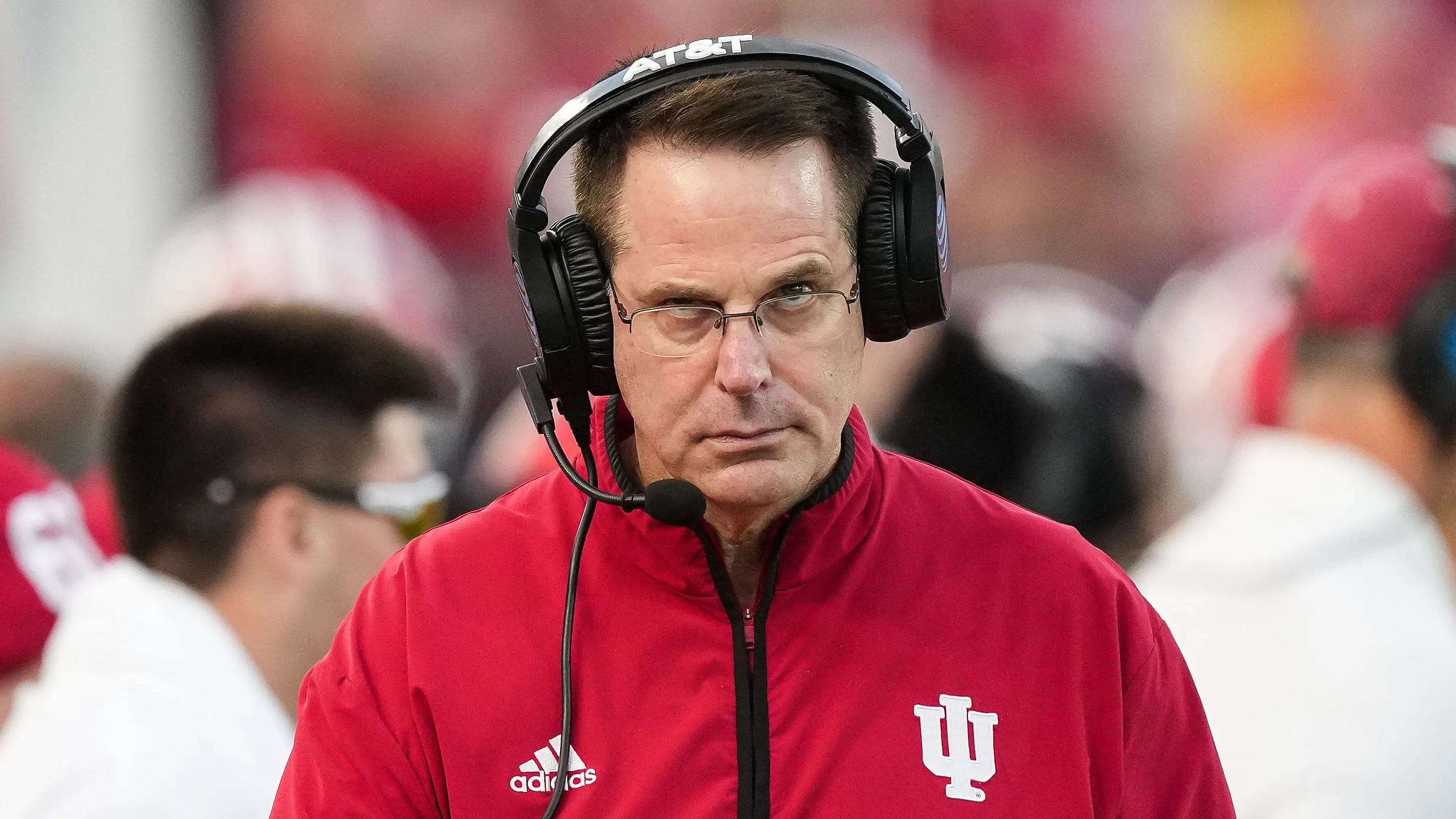
Indiana entered last weekend ranked fourth in the country. The Hoosiers didn’t lose, didn’t suffer some devastating injury during a game and didn’t do anything that would ordinarily cause a football team to plummet down the rankings. In fact, they did nothing at all. They were on a bye, presumable sipping on a Mai Tai and having a great time. (Is that what people do in Bloomington, Indiana?)


By Tuesday evening, Curt Cignetti’s team had fallen five spots to No. 9. Apparently, sitting at home is now among the most dangerous activities in college football.
There were other peculiar developments in the committee’s second rankings. Alabama continued its march toward an increasingly privileged position, the Big 12 strengthened its claim to multiple playoff bids, and the newly approved 24-team CFP offered a rather horrifying glimpse into what awaits us next season.
I have thoughts. Quite a few, actually.
Indiana’s Terrible, Horrible, No Good Bye Week
First, I’d like to hand the microphone to Indiana fan Jason Hiebner, who had some rather pointed observations about the committee’s treatment of his beloved Hoosiers.
“I recognize and fully agree that IU is not currently a top-five team or résumé at this point, but to drop a team five spots on a bye week is one of the most ludicrous things this committee has ever done,” Hiebner angrily texted me.
He continued: “SEC teams are told that wins against a Mississippi State team with Kamario Taylor carry significant weight, but Indiana gets punished for Ohio State and Northwestern losing with backup quarterbacks?
“People want to talk down on our non-conference schedule, but North Texas, by all advanced metrics, is a better opponent than Mississippi State, Clemson, Auburn, West Virginia and Oregon State, to name a few,” Hiebner added. “North Texas may very well end the season as a ranked win, despite Brett McMurphy trying to tarnish us for playing them.”
There is quite a bit to unpack there -- especially the Brett McMurphy slight, which I’ll leave for another day (don’t want to tread in those waters) -- but I agree with the general sentiment. Indiana isn’t one of the five best teams in the country right now, and its placement at No. 4 last week was difficult to defend. The offense has been inconsistent, especially when facing respectable opponents, and the quarterback situation remains unsettled, to say the least.
The defense, however, remains terrific. Indiana is allowing just 12.4 points and 259.2 yards per game, which contributes to ESPN’s SP+ ranking the Hoosiers fifth nationally.
And Hiebner isn’t entirely wrong about North Texas, either. SP+ ranks the Mean Green 52nd, ahead of Mississippi State, Clemson and Auburn. Other models disagree, so describing that comparison as unanimous would be a stretch, but the idea that Indiana’s non-conference schedule contains nothing worthwhile deserves some scrutiny.
The committee’s explanation for the five-spot drop was that all six Big Ten opponents Indiana had faced lost over the weekend, damaging its strength of schedule. Ohio State, the only team to beat the Hoosiers, suffered another defeat and dropped to No. 20.
That’s reasonable information to consider. A team’s résumé changes as we learn more about its opponents.
But there’s an enormous difference between acknowledging new information and deciding that an eight-win team deserves to fall five places without playing. This feels suspiciously like the committee correcting last week’s mistake while pretending it’s simply conducting another independent evaluation.
Somebody Please Explain Alabama and Tennessee
The committee absolutely adores Alabama. At this point, I’m beginning to wonder whether the Crimson Tide have been given a permanent residence somewhere inside the selection room. Perhaps Nick Saban is on the selection committee?
There’s a legitimate case for Alabama being one of the best teams in the country. Keelon Russell has been extraordinary at times, and his ceiling is high enough that another national championship in Tuscaloosa feels like a realistic possibility. The problem is that his worst performances occasionally resemble an expedition to the bottom of the Mariana Trench.
Tennessee knows something about that.
On Oct. 17, the Volunteers beat Alabama 26-10 in Knoxville, holding Russell to 147 passing yards and intercepting him twice. The Crimson Tide managed 201 yards of total offense, converted two of 13 third downs and committed four turnovers.
It wasn’t particularly close.
Both teams now sit at 7-2. Alabama is ranked third, while Tennessee is eighth. The Crimson Tide have impressive victories over LSU and Kentucky, which certainly deserve consideration, but the Volunteers have beaten Alabama and Kentucky themselves.
In fact, here’s a wonderful little statistical coincidence: Both teams beat Kentucky by exactly 28 points. Alabama won 45-17 in September, while Tennessee won 34-6 last Saturday.
The Volunteers’ two losses came by three points apiece against Texas and South Carolina. Alabama also has two defeats, one of which was the aforementioned 16-point humiliation in Knoxville.
Predictive metrics provide some justification for the committee’s decision. ESPN’s Football Power Index ranks Alabama third and Tennessee 11th, suggesting that the Crimson Tide would be favored in a hypothetical rematch.
Fair enough. But they already played the actual game, and Tennessee won convincingly.
I’m not demanding that head-to-head results override everything else. Alabama has a legitimate championship résumé, and Russell might eventually produce the kind of postseason performance that makes this entire argument look ridiculous.
But five spots? Really?
The Big 12 Might Finally Get Its Moment
There was a time, not particularly long ago, when suggesting that the Big 12 might be more interesting than the Big Ten in the national championship conversation would’ve earned you some concerned looks.
Well, welcome to November 2026.
Utah is undefeated and ranked second. BYU sits 10th, with its victory over Notre Dame doing considerable work for an otherwise imperfect résumé. Texas Tech is 12th, while Houston has climbed to 14th. The conference also has Arizona at No. 23 and Oklahoma State at No. 25.
Meanwhile, the Big Ten’s strongest playoff candidates are undefeated UCLA, led by a first-year head coach, and reigning national champion Indiana. Ten years ago, that sentence would’ve sounded like something somebody invented after consuming a questionable substance.
There are still plenty of potential complications. Utah has to survive a difficult closing stretch, while BYU’s two losses leave it vulnerable to another setback. Texas Tech is close enough to the field that a strong finish might change everything.
Still, the prospect of two Big 12 teams making the playoff feels increasingly realistic.
That would be a first for the conference in the 12-team era. Arizona State represented the Big 12 in 2024, and Texas Tech followed in 2025. The league has been close to earning additional bids without quite managing to get there. For example, BYU was dropped out of the field despite having an identical or similar record to other playoff teams last season. Based on the current trajectory, a similar scenario doesn’t seem as likely in 2026.
The Official Corner Poll
The Corner Poll remains an exercise in personal judgment rather than an attempt to reproduce the playoff rankings. Wins matter, obviously, but so do expectations and the emotional response a team produces whenever it appears on my television.
The rankings below reflect how I feel about the teams at this particular moment. There is no complicated voting procedure, no conference enhancement formula and certainly no punishment for taking a bye week.
Just vibes. Wonderful, occasionally inexplicable vibes.
