

Every four years, the world gathers around a soccer ball.
Well, football. We should probably call it football for the purposes of this article, seeing as that’s what roughly 95 percent of the planet calls it. The Americans among us can complain all they want, but when literally billions of people are paying attention to the same event, it feels a little silly to argue semantics.
Whatever you call it, though, there is nothing quite like the FIFA World Cup.
I know that’s a bold statement. Fans of the Olympics will tell you that nothing compares to seeing the world’s greatest athletes gather under one banner. College football fans will point toward the pageantry of a rivalry Saturday in the SEC. The NFL crowd will remind everybody that the Super Bowl routinely dominates television ratings. They’re all wonderful events in their own right — nobody is disputing that claim.
None of them are the World Cup.
The World Cup is different because it somehow manages to be both the biggest sporting event on Earth and the most personal. The Olympics are massive, but they’re fragmented. One person watches gymnastics. Another watches swimming. Somebody else is invested in fencing for a week despite not knowing the rules. The Super Bowl is enormous, but it belongs primarily to one country. The Champions League is elite, but it revolves around clubs rather than nations.
Conversely, the World Cup belongs to everyone.
That might sound cheesy (I’m a cheesy guy, what I can I say), but it’s true. For one month every four years, billions of people wake up, go to work, attend school, sit in traffic, order lunch and live their normal lives knowing that somewhere, later that day, their country might be playing a football match that feels more important than just about anything else. Entire cities stop what they’re doing. Productivity plummets. Families gather around televisions. Strangers hug one another in public. Grown adults cry over goals scored by people they’ve never met.
The ultimate goal of sports is to bring people together. The World Cup is one of the few events left that actually accomplishes that. What makes that fact even more remarkable is that most of the countries participating have absolutely no chance of winning. And that’s not cynicism — that’s just plain history.
Since the first World Cup in 1930, only eight countries have ever lifted the trophy. Think about that for a second. Nearly a century of competition that’s featured hundreds of talented teams and thousands of world-class players. Just eight champions.
Brazil. Germany. Italy. Argentina. France. Uruguay. England. Spain.
That’s the list.
The odds are overwhelmingly in favor of the 2026 champion coming from that group once again. Maybe Brazil finally redeems itself after years of disappointment. Maybe Argentina finds a way to repeat. Maybe Spain announces the beginning of a new dynasty. Maybe England finally, finally discovers a way to stop turning every major tournament into a national therapy session.
But here’s the thing: the champion isn’t really what makes the World Cup special. The journey does.
For every Brazil supporter dreaming about a sixth star, there is a Curacao supporter simply thrilled to be here. For every England supporter agonizing over whether football is finally coming home, there is a Scottish supporter figuring out which American city can withstand an invasion of tens of thousands of kilt-wearing fans whose aim is to drink every bar and stadium dry. For every French supporter expecting a semifinal appearance, there is a Haitian supporter just happy to see their flag represented on the biggest stage in sports after years of instability.
The dreams aren’t the same, and that’s the entire point.
Mexico enters every World Cup carrying the weight of the quinto partido, that elusive fifth game that has haunted generations of fans. The United States arrives with an opportunity unlike anything it has ever experienced, hosting the tournament and possessing a roster talented enough to make genuine noise. Norway finally gets to unleash Erling Haaland on the world’s biggest stage after years of watching him score goals everywhere except the World Cup. South Korea may be witnessing the final great chapter of Son Heung-min’s international career. The Netherlands is once again chasing a first title despite producing some of the greatest teams the sport has ever seen.
Even the countries expected to contend for the trophy come with fascinating baggage.
Brazil isn’t just trying to win — it’s trying to redeem itself. Germany isn’t simply chasing another title — it’s attempting to remind the world that one of football’s traditional giants still belongs among the elite. And then Belgium is desperately trying to avoid becoming the answer to a trivia question about the greatest golden generation that never won anything.
And then there are the two men who have defined football for the better part of two decades: Lionel Messi and Cristiano Ronaldo.
You don’t need to understand football to understand what those names mean. Their rivalry transcended the sport years ago. Entire childhoods have been spent arguing over which one was better. Every goal, every trophy and every individual accolade seemed to become ammunition in a conversation that never really had an answer.
For nearly 20 years, football has belonged to Messi and Ronaldo. They weren’t merely stars — they became landmarks. They were constants in a sport that changes constantly. Managers came and went, teammates retired, tactics evolved and entire generations of players rose and fell. Yet Messi and Ronaldo remained, scoring impossible goals and producing moments that somehow managed to exceed impossibly high expectations over and over again.
Despite all that longevity, the end is finally beginning to crest over the horizon.
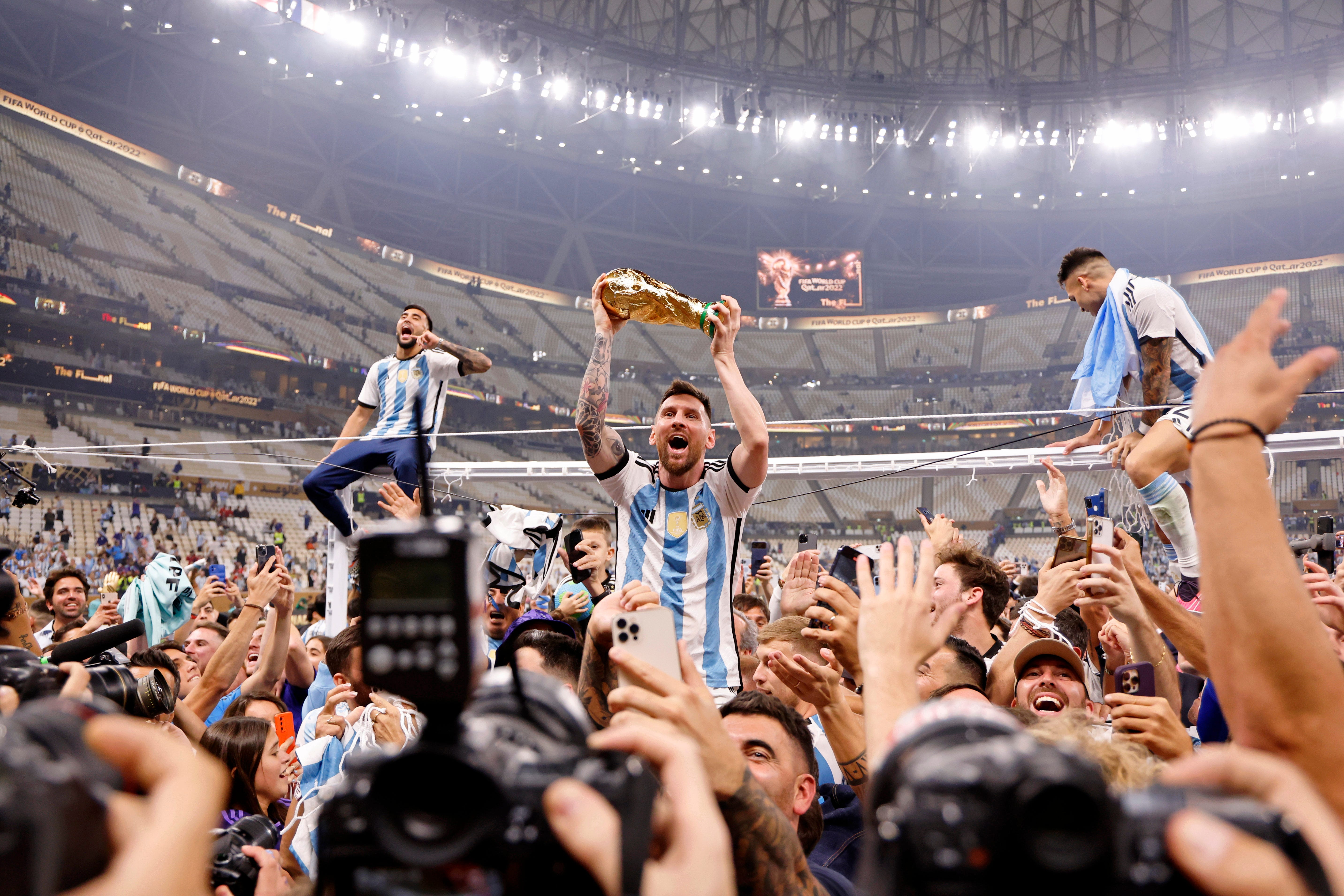
Messi already has his storybook ending in many ways. The image of him lifting the World Cup trophy in Qatar in 2022 will forever be one of the defining photographs in sports history. Ronaldo’s journey has been different. He has conquered nearly every mountain football placed in front of him, yet the biggest trophy in the sport remains frustratingly out of reach. Whether either player can realistically win the tournament in 2026 almost doesn’t matter. The opportunity to watch them walk onto a World Cup pitch one final time is a gift in itself. Future generations will hear stories about Messi and Ronaldo the same way older fans tell stories about the likes of Pele, Maradona and countless other legends. This tournament may be the last chapter of that story.
And yet, somehow, even that isn’t the biggest storyline — at least in my opinion.
This is the first 48-team World Cup. The biggest tournament in the history of the sport. More countries are participating than ever before, which means more supporters, more cultures, more styles of football and more dreams arriving in one place. A Curacao supporter will be sharing space with an Argentina supporter. Scottish fans will be filling bars alongside Mexican fans. Nations that have never experienced a World Cup before will suddenly find themselves competing under the brightest lights imaginable.
Some people will complain about expansion because people always complain about expansion. (As an ardent college football fan, trust me, the expansion arguments are never a fun place to dabble.) That’s their right. Personally, I can’t wait.
The World Cup was already the greatest tournament on Earth. Now there are more stories than ever before. More opportunities for a tiny nation to shock giants. More chances for a player nobody has ever heard of to become a national hero overnight. More possibilities for magic, chaos and everything in between.
Somebody is going to win the whole thing. They always do. But if history has taught us anything, the trophy is only part of the story.
The World Cup has never been about one team.
It’s about all of them.