

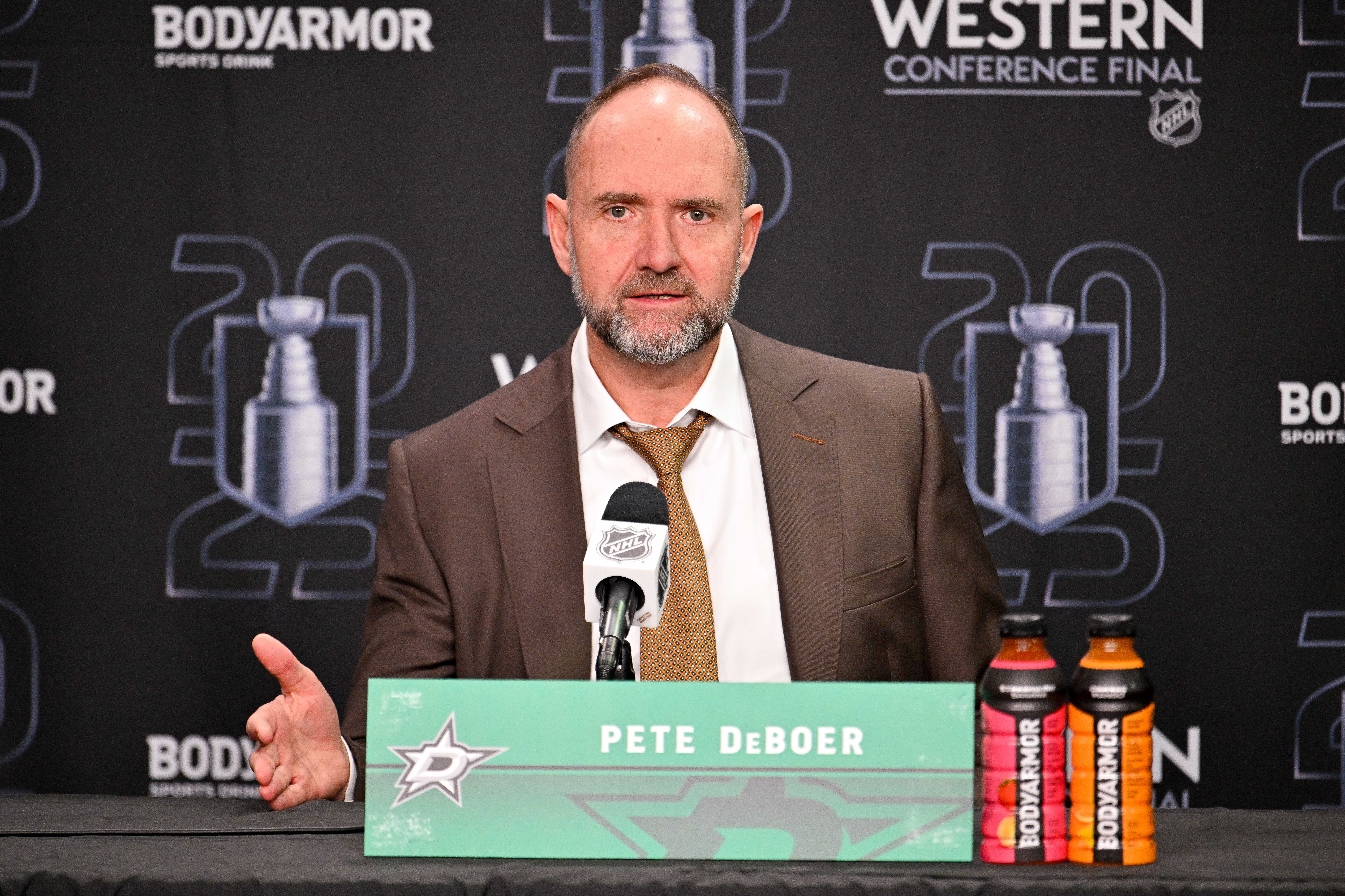
Last Friday, Pete DeBoer was fired by the Dallas Stars.
There’s been a lot of hand-wringing regarding the decision to let go of DeBoer, with the main naysayers pointing out that the Stars possessed the best record in the NHL in the regular season over his three years in Dallas. On top of that significant achievement, he also was a main factor in the team winding up in the Western Conference Finals three consecutive seasons. With those accomplishments, you could even make the argument that DeBoer is the most successful head coach in Dallas Stars history, with the exception of Ken Hitchcock Version 1.0. That’s got to count for something, right?
It certainly does. DeBoer’s merits as a head coach when it comes to wins and losses in the regular season are well documented. Dating back to the start of his tenure in San Jose in 2015, DeBoer’s teams have won 45 or more regular-season contests seven times. Two of the instances where that didn’t happen were due to extenuating circumstances, such as taking over a job mid-season (2019-20 with Vegas) or the pandemic limiting the number of games the team played (2020-21 with Vegas). Besides, those two seasons were some of his most successful—he made it to the Conference Finals with Vegas in both and lost.
Oh, there it is again. Losing in the Conference Finals. That's a part of the “Pete DeBoer Problem.” Sure, the regular season is usually a piece of cake for teams under his watch, but the late goings of the postseason are an entirely different story.
It’s a somewhat baffling phenomenon due to his repeated success in those late rounds early in his head coaching career. While his three-year tenure with the Florida Panthers from 2008-11 was fairly unsuccessful, his time in New Jersey marked the first moment where people woke up to what a Pete DeBoer-coached team could accomplish. In his first season with the Devils, New Jersey finished fourth in the Atlantic with 102 points and made it all the way to the Stanley Cup Finals, where it’d lose to Los Angeles in six games. Fast-forward to 2015, when the Devils let go of DeBoer and the San Jose Sharks scooped him right up. That Sharks team made the playoffs, marking just the second time in DeBoer’s coaching career that a team he headed made the postseason, and then marched its way to the Stanley Cup Finals, where Sidney Crosby and the Pittsburgh Penguins did their thing and won it all. Two shots at a Cup, two failures.
But hey, that’s not all bad. Getting to the Stanley Cup Finals is an incredible achievement, one that many head coaches around hockey would die for. Still, he’d yet to win one, and as long as he hadn’t touched the sport’s greatest trophy, the questions of whether or not he could actually do it would continue to ring on and on and on.
Today, those questions remain evergreen. Since that trip to the Stanley Cup Finals in 2015-16, DeBoer’s teams have made the playoffs a whopping eight times. Never once has any of those teams touched the final round of the postseason.
The Stars clearly didn’t want to become stuck in that purgatory forever. So, instead of riding it out for one more year, hoping that DeBoer would buck the history, they decided to move on to find someone else who could coach this star-studded roster toward a Cup.
But that’s just one part of the Pete DeBoer Problem.
Pete DeBoer can’t stop benching his star goalies. It happened two weeks ago, and it’s happened in the distant past.
In Game 5 of this year’s Western Conference Finals against the Edmonton Oilers, DeBoer made the decision to bench Jake Oettinger after the Stars’ franchise goalie let in two A-grade chances just seven minutes in. It was a bold, yet rash, decision that at the time felt like a coach trying to pull every last lever imaginable to attempt to will his team to a win.
Needless to say, it failed, and it failed tremendously. Backup Casey DeSmith, who’s beloved in the locker room and was fantastic all season, gave up a goal a couple of minutes into his tenure in the game to make it 3-0 Oilers. Taking Oettinger out of the game was supposed to light a fire under the Stars’ butts. Instead, it seemed to make them put their metaphorical tails between their legs and give up.
DeBoer was grilled about this decision on every part of the earth. Online, fans were calling for him to lose his job (I bet those people are happy right now). Even rational fans who don’t pull the trigger so easily struggled to see the reasoning behind the decision. It was a baffling one, that’s for sure.
To his credit, DeBoer didn’t back down when asked about it after the game. His explanation for why he pulled Oettinger, however, was less than pleasing to the ear.
DeBoer: Any time you pull a goalie, the reason is always to try and spark your group, so that was the number one reason.
I can understand this. No qualms here, Pete!
DeBoer: We had talked endlessly in this series about trying to play with a lead. And obviously, we’re in a 2-0 hole right away. And you know what, I didn’t take that lightly, and I didn’t blame it all on Jake.
That’s good to hear. I certainly wouldn’t want him to blame it all on the franchise’s star goalie who’s going to be here for seven more seasons.
DeBoer: But the reality is, if you go back to last year’s playoffs, he’s lost six of seven games to Edmonton, and we gave up two shots on two goals in an elimination game. It was partly to spark our team and wake them up and partly knowing that the status quo had not been working. And that’s a pretty big sample size.
Oh. It kind of sounds as most, if not all, of it was on Oettinger, at least according to DeBoer.
It is true that Oettinger and the Stars have lost six of seven games to the Oilers over the past two postseasons, and, frankly, it hasn’t been pretty. The context in which that occurred needs to enter the conversation, though. Dallas’ offense completely dried up in both series, with the power play completely not working in 2024, and then the offense as a whole not clicking in 2025.
Were there some goals that Oettinger probably shouldn’t have let in? Potentially. But I think that when we look back at these two series against Edmonton the past two seasons, Oettinger’s performance is not going to be the main billing as to why the Stars lost. So, making him the scapegoat for the rest of the team’s failures is quite rich. It feels like a coach refusing to take responsibility for his own actions.
It does need to be pointed out that throughout the press conferences that followed the Game 5 loss, DeBoer did reiterate multiple times that it wasn’t all Oettinger’s fault. There’s still enough evidence in his words, though, that points toward the greater point of refusing to take accountability, such as not taking a firm stance on whether this Stars team was the best he’d coached while in Dallas.
“I’m not sure it was,” he conceded after Game 5. “Maybe on paper. I’m not sure it was the best team. I’ll have to look at it.”
Mikko Rantanen is on this team, for crying out loud! To me, and I might just be reading between the lines a little too hard, it sounds like a subtle jab at the front office. Yeah, on paper, this is the best team, but was it really? I’d disagree with DeBoer’s assessment there, and it’s evident that Nill probably did as well.
Here’s one more quote from DeBoer regarding the Oettinger decision, followed by some fantastic analysis by the great Robert Tiffin of Stars Thoughts.
“I think from a coaching perspective, we’re one-and-seven against that team at this time of year, in the Conference Finals,” he said. “So everything’s on the table: lineup decisions, goaltending decisions, system decisions. Everything’s on the table. You’re looking for some type of way to flip that momentum, because it’s not a small sample size. One-and-seven is not a small sample size. That’s not just on Jake; that’s on our entire group. We scratched veteran guys in order to try and change that. We moved guys up and down the lineup. We switched lines. We switched power-play units. I mean, you’re looking for solutions in order to try and flip that momentum, and the goaltending is one piece of that. I think Jake is the best young goaltender in the league. But that doesn’t mean there’s not still a learning curve and growth. That’s all part of the journey.”

Yanking Oettinger isn’t the problem. It’s throwing him under the bus after the fact that seemed to irk players in the locker room and people in the front office. It’s that inability to communicate—DeBoer said in what would be his final press conference as the Stars’ head coach that he’d yet to speak with Oettinger regarding the situation during Game 5—that ultimately, in my opinion, ended his tenure in Dallas.
Actually, don’t take it from me. Take it from general manager Jim Nill, who had this to say when he was asked if he had a problem with what DeBoer said: “I think everybody did.”
This isn’t just a one-time occurrence. DeBoer has ticked off his starting goalie before, back when he was the head man in Vegas. During the 2020 bubble playoffs, DeBoer decided to not start future Hall of Famer Marc-Andre Fleury in round one against Chicago, putting Robin Lehner in net instead. While Fleury himself didn’t publicly tear down his head coach, his agent, Allan Walsh, sure did, as he posted this now-deleted picture on Twitter:
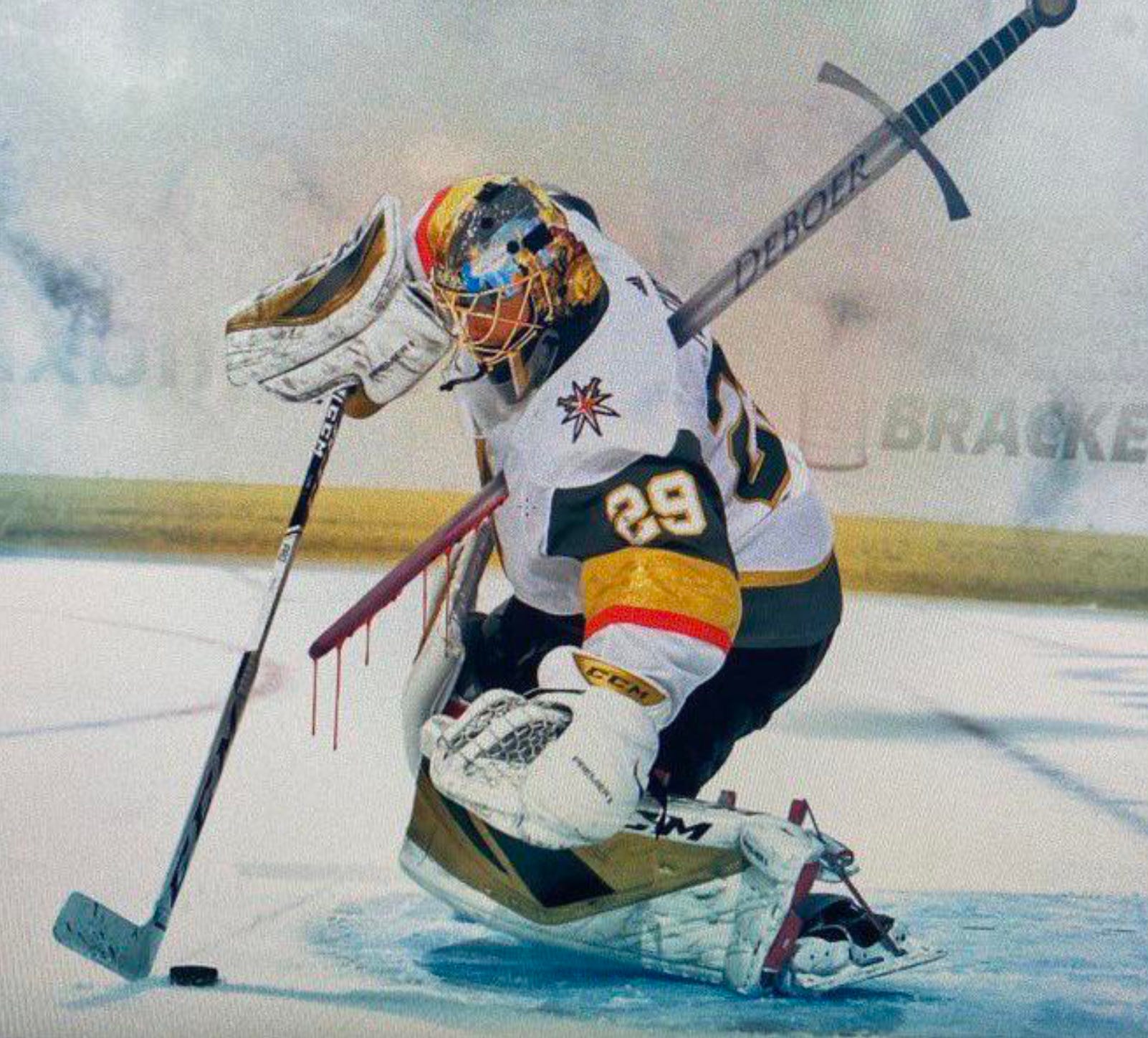
Fleury’s contributions to the Golden Knights have been well documented. He led Vegas to the Stanley Cup Finals in the franchise’s first season in 2018 and was a top-five goalie in the league throughout his time in Nevada. In a vacuum, benching him seemed ludicrous, but within the context of the situation, it makes much more sense. Lehner’s save percentage (.904) since arriving in Vegas midway through that 2019-20 season was better than Fleury’s (.886).
It still didn’t sit well with either Fleury or his agent, and from what I can tell, there hasn’t been any love lost between the two sides in the intervening years. Just months after the benching, the Golden Knights traded Fleury to Chicago, and that was that. DeBoer would be out the door soon as well, as Vegas fired him following the 2021-22 season.
Sure, it’s a different situation than the one that occurred in Dallas just two weeks ago, but it illustrates the point: DeBoer’s relationship with goalies has been rocky in the past. And Jim Nill and the front office did what Vegas seemingly refused to do back in 2020 and sided with the goalie. DeBoer might’ve won the battle in the moment, but Oettinger ended up winning the war.
Contrary to everything I’ve been saying, Pete DeBoer is a really good hockey coach. While his inability to achieve what all head coaches aspire to achieve—the Stanley Cup—has been one aspect of his downfall in Dallas, his frequent ability to continuously win regular-season games is a clear sign that he has the chops. If you don’t believe me, take Stars’ owner Tom Gaglardi, who had this to say after Dallas lost Game 5 two weeks ago: “He’s a top-three, top-five coach in the league.”
And yet, here we are. While everybody’s question in Dallas is about where the Stars will turn for a new head coach, I can’t help but be left wondering where Pete DeBoer will wind up. Apart from the Stars, there are no other head coaching vacancies in the NHL. As such, it appears that the 2025-26 season will be the first season in 17 years that DeBoer isn’t a head coach in hockey’s best league.
I hope he lands on his feet somewhere. Despite the challenges he’s had with some goalies, everything I’ve heard surrounding DeBoer and his interactions with most players has been positive. While that shouldn’t be the number one component when it comes to a coaching hire, it should certainly be near the top of the list.
It’s the potential victories that he brings that make him an attractive candidate for a job. If you hire Pete DeBoer, you will win hockey games, there’s no doubt about that. Now, how far he can take you when the lights get bright and the going gets tough is an entirely different question, but nobody can claim that he doesn’t have the ability to get his teams at least close to the promised land. And while that wasn’t enough for the Dallas Stars, it’s probably enough for somebody else, and that, in my opinion, will be to their benefit.