

The following is an excerpt from this week’s The Football Notebook. To read the full article, subscribe and click the link below.

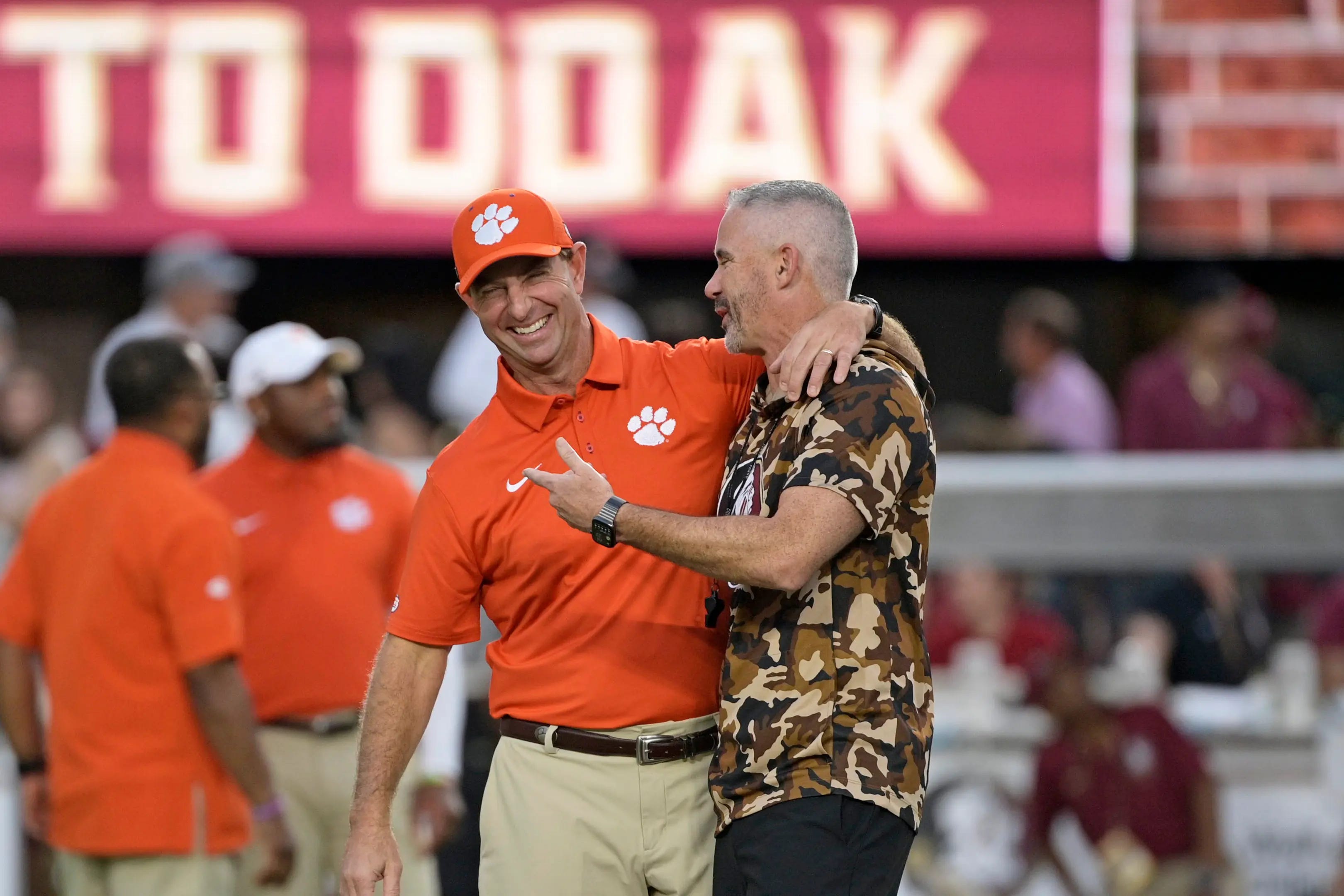
There is a fairly simple argument for firing Mike Norvell, and it doesn’t require much beyond looking at Florida State’s record over the past three seasons. The Seminoles went 2-10 in 2024, followed that with a 5-7 campaign in 2025 and have started this season 3-5, with Saturday’s 36-24 loss to Clemson proving to be the final straw. That’s 10 victories in 32 games for a program that entered the 2024 season believing it had one of the best coaches in college football. If Florida State had finished 8-4 in each of those seasons, we’d be having a very different conversation. But it didn’t, and there is only so long an administration can continue insisting that a successful turnaround is right around the corner before everybody stops believing it.
So Norvell is gone, which is an outcome that has seemed likely for most of the past two years. Florida State announced his dismissal Sunday, named Rick Stockstill its interim coach and began the search for somebody capable of restoring the program to something resembling its former standing. None of that is surprising, although I do find it remarkable that the Seminoles managed to tolerate so much losing before reaching a conclusion that many people thought was obvious after the 2024 season.
What is surprising, or at least what ought to be surprising, is how much money Florida State will have to pay to make the change. Depending on which report and contract calculation you use, Norvell’s buyout is worth somewhere around $47 million to $50 million, with the costs of dismissing other members of his staff potentially pushing the total much higher. Even allowing for the fact that his future earnings could reduce what Florida State ultimately owes, this is an enormous amount of money to spend on somebody the university no longer wants to employ.
And before we get too far into the discussion, I should clarify something. I don’t blame Norvell for negotiating the contract that put him in this position, because I don’t believe there’s a person reading this who would have turned down the same arrangement. If somebody offered me more than $10 million a year to coach college football and promised to pay me tens of millions more if they eventually decided I wasn’t very good at it, I would accept before they had an opportunity to reconsider. I’d probably even offer to pay for lunch afterward.
But that’s a rather different question from whether Florida State should have agreed to those terms, and I think the distinction matters. We’ve developed a habit of examining coaching contracts only after they’ve become financial disasters, then treating the entire arrangement as though it was obviously a terrible idea from the beginning. Sometimes that’s true, but I’m not convinced it was entirely true in this case. The real problem is that Florida State made a defensible decision in 2024 without doing enough to protect itself against the possibility that its assumptions about the future might be wrong.
To understand how we got here, we need to return to the end of the 2023 season, when Norvell was one of the hottest names in college football and Florida State appeared to have restored itself to national prominence. The Seminoles went undefeated through the ACC championship game, finishing 13-0 and winning their first conference title in nearly a decade. They had gone 10-3 the previous season, and the improvement under Norvell looked genuine. Florida State wasn’t winning games because of some unusual statistical fluke or a series of fortunate bounces. It had assembled a talented roster and was beating good football teams.
Then Jordan Travis suffered a season-ending injury, and the College Football Playoff committee decided the Seminoles were no longer deserving of a place in the four-team field. I’m not going to spend another thousand words explaining why that decision was wrong, although I certainly could, because it remains one of the most irritating things I’ve witnessed in college football. Florida State did everything asked of it and was punished for an injury to its quarterback, a standard that wasn’t applied with anything resembling consistency. The Seminoles deserved to play for a national championship, and the fact that they weren’t allowed to remains a stain on the final year of the four-team playoff.
The point, though, is that Florida State had every reason to believe its program was moving in the right direction. Norvell had inherited a mess, worked through some difficult early seasons and produced a team that won 13 consecutive games against legitimate competition. If you’d asked me in December 2023 whether the Seminoles should try to keep him, I would have said yes without much hesitation. I suspect most people who follow college football would have agreed.
Then Nick Saban retired at Alabama, which changed the entire calculation.
The Crimson Tide needed a replacement for the most successful coach of the modern era, and Norvell’s name emerged among the leading candidates. Washington’s Kalen DeBoer was another obvious possibility, having just led the Huskies to the national championship game, but Florida State had no way of knowing which direction Alabama would go. Norvell was coming off an undefeated conference championship season, his reputation had never been higher, and the Seminoles were faced with the prospect of losing the man responsible for their revival at the worst possible moment.
Florida State responded by giving Norvell an eight-year extension worth more than $84 million, keeping him under contract through 2031 and placing him among the highest-paid coaches in the sport. DeBoer eventually took the Alabama job, Norvell remained in Tallahassee, and the Seminoles could congratulate themselves for making sure their head coach wasn’t going anywhere. At the time, that probably seemed like a good outcome for everybody involved, especially the people responsible for convincing wealthy Florida State supporters that the program was prepared to compete for championships.
I don’t think the decision to retain Norvell was foolish. In fact, I think the university would have been criticized far more heavily had it allowed him to leave after a 13-win season without making a serious effort to keep him. The problem was the structure of the agreement, which assumed that preventing Norvell from leaving was worth exposing the university to a massive financial penalty if it eventually wanted him gone. Florida State wasn’t merely paying for the coach it already had. It was betting that the coach it had would continue being successful for most of the next decade.
That’s an important distinction because good coaching decisions and good coaching outcomes aren’t the same thing. Sometimes a university hires somebody who looks like an excellent candidate, only to discover three years later that the arrangement isn’t working. Sometimes a coach who appeared to be heading toward unemployment turns everything around and becomes a national championship contender. There are too many variables involved in college football for anybody to be certain about what will happen, and pretending otherwise is a good way to get yourself into trouble.
If I’m Florida State in January 2024, I’m operating under the assumption that Norvell is more likely to succeed than fail. The evidence supports that belief, and losing him to Alabama would have created a difficult situation for a program that had just enjoyed its best season in years. But I’m also asking what happens if the program takes a step backward, or if the transfer portal additions don’t work out, or if the roster loses more talent than it can replace. Those aren’t unlikely scenarios. They’re the sorts of things that happen to football programs every single season, which is why guaranteeing so much money to one person strikes me as an unnecessary risk.
Of course, I doubt anybody at Florida State expected the worst-case scenario to arrive quite so quickly.
The Seminoles went 2-10 in 2024, producing one of the most embarrassing seasons in the program’s history. The offense was dreadful, the transfers failed to deliver what had been promised, and the team often looked incapable of competing against opponents it would have expected to beat a year earlier. There were plenty of explanations for why things went wrong, but none of them changed the scoreboard. Florida State had gone from being undefeated in conference championship week to losing 10 games in the span of a year, and there wasn’t much reason to believe the decline was some temporary statistical accident.
At most programs, that would have been enough to get the coach fired. Florida State is not supposed to go 2-10, and it certainly isn’t supposed to go 2-10 while paying its head coach more than $10 million annually. Yet Norvell survived, in part because dismissing him would have required the university to absorb one of the largest buyouts in college football history. It was a difficult position, and I can understand why Florida State’s administrators hoped another season might produce a turnaround.
That doesn’t mean keeping him was necessarily the wrong decision, either. One of the problems with college football’s coaching carousel is that administrators often react to disappointing seasons as though every setback proves that a coach has forgotten how to do his job. Norvell had demonstrated the ability to win at Florida State, and there was at least a plausible argument that the 2024 season represented an extreme collapse from which the program might recover. Giving him another year wasn’t an outrageous choice, even if there were plenty of reasons to be skeptical.
But that argument became harder to make in 2025, when Florida State went 5-7 despite opening the season with a victory over Alabama. The Seminoles showed enough early promise to suggest that the previous year might have been an exception, only to spend the rest of the campaign proving that the program’s problems had not been fixed. Norvell made changes, brought in new players and tried to give supporters reasons to believe. The results didn’t support the optimism, and the margin for error entering 2026 had become awfully small.
By this point, Florida State’s administration was dealing with two separate questions. One was whether Norvell remained the right person to coach the Seminoles, and the other was whether the program could justify spending tens of millions of dollars to replace him. Those questions were related, but they weren’t identical. Keeping a coach because you believe he’s likely to improve the program is one thing. Keeping him because you’ve already committed so much money that admitting the mistake feels unbearable is another.
That’s where these contracts become dangerous, because the money already committed begins influencing decisions that ought to be based on what gives the football program its best chance of succeeding. There are legitimate financial reasons to delay a coaching change, including the immediate costs of a buyout and the expense of hiring a replacement. But there is also a cost to continuing down a path that isn’t working, particularly when every disappointing season makes the program less attractive to recruits and harder to sell to supporters.
Florida State finally decided that the second cost had become greater than the first. Following Saturday’s loss to Clemson, a game the Seminoles entered as favorites, the administration determined that enough evidence had accumulated to justify moving on. I think that’s the right decision, although it would have been better for everybody involved if the university hadn’t spent the past three seasons reaching it.
The broader issue is that Florida State isn’t alone. Texas A&M paid Jimbo Fisher more than $75 million to leave in 2023, and LSU found itself facing another enormous buyout when it dismissed Brian Kelly last year. There are other coaches around the country whose contracts would make separating from them a difficult financial undertaking, often because an athletic director became frightened that somebody else might offer a better deal. The numbers have reached the point where a coach getting fired is sometimes less interesting than the amount of money the school has agreed to pay him afterward.
Why does this keep happening? I think the answer has a lot to do with the incentives facing the people making these decisions. An athletic director who loses a successful coach to another school faces immediate anger from fans and donors, while an athletic director who gives that same coach a massive extension usually receives praise for demonstrating ambition. The contract’s risks might not become apparent for several years, by which point the administrator responsible for negotiating it may have moved on to another job. Meanwhile, the coach and his agent have every reason to push for as much guaranteed money as possible, because that’s what they’re being paid to do.
It’s a system that rewards short-term thinking, even though everybody involved insists they’re making decisions for the long-term health of the program. Florida State could have offered Norvell a substantial raise without agreeing to the sort of financial protection that now makes his dismissal so expensive. The Seminoles might have risked losing him, but that risk needed to be weighed against the possibility of being stuck with a coach who wasn’t winning. Instead, the university paid a premium to avoid one outcome and ended up suffering an even more expensive one.
And there is a broader question about the value of a head coach that I think deserves more attention. We’re accustomed to discussing the position as though the right person can transform an entire football program through sheer force of personality, and there are certainly coaches who have demonstrated an ability to do that. But successful teams also depend on recruiting departments, coordinators, financial resources and the players themselves. Florida State had all of those things working in its favor in 2023, and when several of them began to break down, Norvell proved unable to compensate.
Perhaps that’s the real lesson here. Athletic departments place so much emphasis on retaining or acquiring a famous coach that they sometimes forget the rest of the organization matters, too. Florida State invested an enormous amount of money in the person at the top, then discovered that the name on the office door wasn’t enough to prevent everything underneath him from falling apart.
The Seminoles will now begin another coaching search, presumably hoping to find somebody who can reproduce the success Norvell briefly delivered. Whoever gets the job will inherit a program with plenty of resources and a fan base that has become understandably tired of losing. I hope Florida State finds the right person, but I also hope the university has learned that no coach is worth surrendering its ability to change course when things go wrong.
Because the most remarkable part of this entire story isn’t that Mike Norvell got fired. It’s that Florida State had to spend around $50 million to do something everybody knew was coming.