

When asked what the hardest thing to do in sports is, Deion Sanders immediately responded with this answer: “Any sport where you could fail seven out of 10 times and still become great and make $200-to-300 million in it, that’s a hard sport.”
A hitter has approximately 125 milliseconds to decide whether to swing at a pitch or not, and to everyone’s disbelief, 20-to-30% of the time, they succeed in getting a base hit. It’s an astounding achievement that’s often overlooked because of how easy professional hitters like Shohei Ohtani, Aaron Judge, and Bobby Witt Jr. make it look. But it’s not easy. They’ll tell you as much. The Texas Rangers will certainly reiterate that point right now.
As I outlined in the Rangers Roundup yesterday, Texas entered last night’s game against the Cubs with the worst offense in MLB. Those figures only got worse — the team is slashing an abysmal .184/.257/.323 (.580 OPS)1 — after their performance at Wrigley Field yesterday evening, as the Rangers lost 7-0 and mustered just three hits (all singles) against Justin Steele and Colin Rea. (Kyle Higashioka collected two of the base knocks while Adolis García had the other.) Yes, the weather was excruciatingly chilly — the temperature at first pitch was 34 degrees — but the Cubs were playing in the same environment and still managed to put up seven runs on 10 hits.
The Rangers are 8-3 and still have the best record in the American League. On its face, there should be nothing to complain about. If you had told me that we’d be just over a week into the season and Texas would be leading the division while the rest of the teams in the AL West were struggling to keep up, I’d have been elated! Unfortunately (or perhaps fortunately in the case of the offense), eleven baseball games provide a small sample size for those seeking to project what a team can do in the long run. The rational thing to do is sit back and wait. However, fans, especially baseball fans, are anything but rational.
But is the sample size really that small? The Rangers were the American League’s best offense in 2023 but regressed significantly in 2024, contributing to the team’s overall lack of success in their title defense. If this is a continuation of last season’s trend, then there is major reason to be concerned. If it’s just a slump to start this specific season, then there is reason for optimism.
There’s no denying that last night’s drubbing in Chicago was concerning. In many ways, it encapsulated the offensive experience for the Rangers so far in 2025: bad at-bats that feature a terrible approach, weak contact, rolling over baseballs, and continued no-shows from the supposed top dogs in the lineup. Perhaps the most concerning aspect of the affair was that, four batters into the game, the Rangers had a man on second base. That didn’t happen again for the rest of the night.
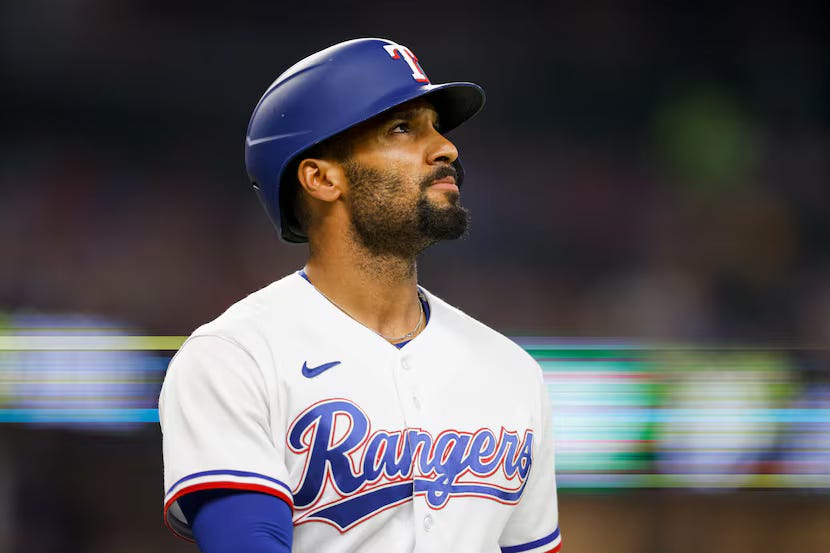
Marcus Semien and Corey Seager’s lack of offensive output is especially concerning given their previous track record and their salaries. Semien’s slash line through 11 contests is a terrible .125/.186/.200 (.386 OPS), while Seager’s isn’t much better at .161/.235/.258 (.493 OPS). They’re the two players who set the tone at the top of the lineup, and so far, they’ve done anything but. Semien looks lost, while Seager doesn’t appear to be himself. It’s a confusing conundrum, and the only thing that manager Bruce Bochy can do is continue to roll them out there every day and hope that a switch flips. When Semien and Seager are humming, the rest of the lineup usually follows.
The new acquisitions of Joc Pederson and Jake Burger have also disappointed early. These two were brought in to bring pop to a lineup that sorely missed it last season. So far, there’s been zero pop and, therefore, almost zero impact. Like Semien and Seager, Pederson and Burger look as lost as ever at the plate, with Burger especially searching for answers. Burger's opening slash line of .105/.150/.289 (.439 OPS) is pretty rough. Pederson's isn't much better at .107/.242/.143 (.385 OPS).
According to the OPS+ statistic2, Texas only employs five players — Kyle Higashioka (103), Josh Smith (174), Wyatt Langford (122), Adolis García (106), and Jonah Heim (141) — who are hitting above the league average at the moment. Of that group, Smith, Heim, and Langford are the only three who have been performing at an average-to-high level for the entirety of the season. With García cooling off from his hot start (he's still hitting the ball hard and is just getting a bit unlucky), it's just Smith, Heim, and Langford that the Rangers can consistently rely on to get on base at the moment. As such, they are the only silver linings in the midst of the struggles.
So, what’s the cure? Well, it might be as simple as waiting out the slump. “There’s just no way that this group of players will continue to perform this poorly, given their previous track record,” is probably what the front office and coaching staff are telling themselves at this very moment. Or maybe there’s a mass panic within the organization. Who knows?
Personally, I find it hard to believe that Texas will continue to hit .184 for an entire 162-game season. How much higher that figure gets is definitely a pertinent question, but for now, I say we should just be patient and wait this out. To use the cliché, it’s really early. There are a lot of baseball games to be played, and the optimist in me keeps saying that these players will figure it out before long. They better, because if they keep hitting like this, they’re going to start losing more than they are winning, which, if you don’t know, is the exact opposite goal of this whole sports shebang.
Tonight, the Rangers will brave the cold temperatures yet again as they face the Cubs in the second game of this three-game series at Wrigley. Hitting in colder weather is hard, but the Rangers desperately need to give their fans a bit of reprieve, or some of us will start to hit the panic button.
Yuck.
According to MLB, OPS+ “takes a player's on-base plus slugging percentage and normalizes the number across the entire league. It accounts for external factors like ballparks. It then adjusts so a score of 100 is league average, and 150 is 50 percent better than the league average.”
Good pitching beats good hitting as a general rule. If asked would we rather be 8-3 because of our pitching or hitting, we would say pitching every time. Also, I would rather be worried about when Corey and Marcus figure it out versus Jack, Kumar or Tyler figuring it out. But you can only win so many 1-0 games. The rotation needs some low stress wins. Jung is going to be active but he is going to replace the one ranger who is hitting. Do we DH one of the Joshs?