

There are dozens of teams capable of having good college football seasons in 2026. There are probably 15 or so with a legitimate path to the College Football Playoff, and depending on how loose you want to get with the word “contender,” somewhere between six and 10 could talk themselves into believing a national championship is actually possible.
But there are four teams I keep coming back to: Texas, Texas A&M, Indiana and LSU.
These aren’t necessarily the four best teams in college football, though some or all of them could eventually fit that description depending on how the season unfolds. No, they’re the four squads I believe will have the largest impact on how we experience this season. Texas enters another year with a loaded roster and national championship expectations after failing to reach the playoff in 2025. Texas A&M finally broke through under Mike Elko and now has to prove it wasn’t a one-year excursion toward greatness. LSU, meanwhile, handed Lane Kiffin the keys to the castle and told him that he can do whatever the heck he wants.


And then there’s Indiana.
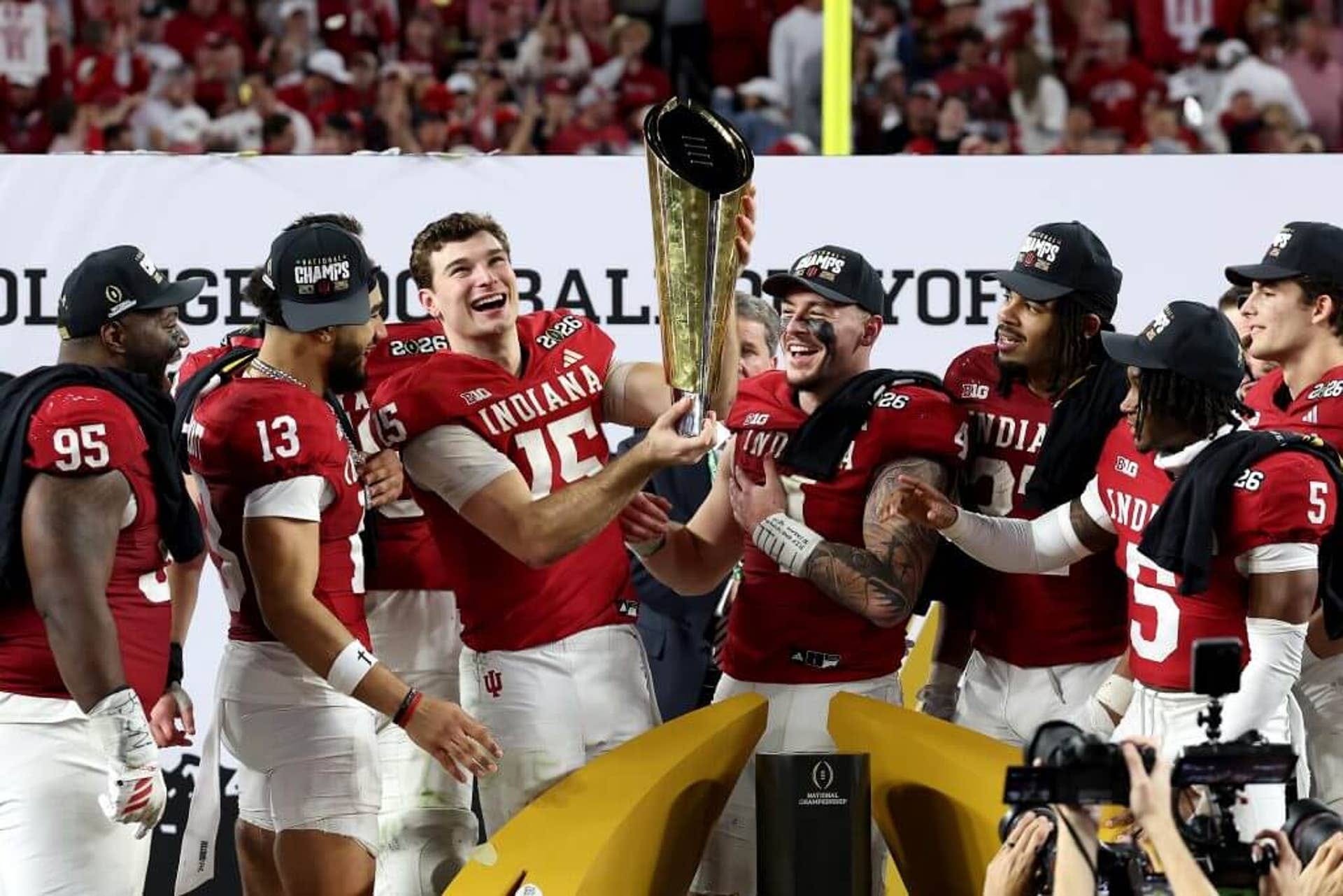
There probably isn’t a stranger sentence in college football right now than this one: The Indiana Hoosiers are the defending national champions.
Two years after Curt Cignetti inherited a program that had won three games the season before, Indiana went 16-0, won the Big Ten, captured the national championship and completely rewrote what Hoosier football can be.
Indiana isn’t sneaking up on anyone anymore. The Hoosiers enter 2026 with legitimate expectations to contend for another title, even after losing a Heisman Trophy-winning quarterback and several other important pieces from last year’s team. The question is no longer whether Indiana can belong among college football’s elite. It’s whether Cignetti has built something capable of staying there.
There are few people I’d rather ask about that than my friend Jason Hiebner, easily the biggest Indiana fan I know and also one of the smartest college football brains I know. So, with Indiana attempting to defend a national championship — still an objectively ridiculous collection of English words — I wanted to know how Jason is processing the Hoosier’s new reality and whether another run at the top of the sport is actually possible.
First things first: Does saying “Indiana is the defending national champion” feel normal yet?
Jason: No, and I don’t think it ever will. Before Cignetti, I thought the mountaintop of Indiana football was Michael Penix Jr. beating Penn State in 2020, in a game, fittingly enough, where no Hoosier fans were able to be in attendance. The last time the Hoosiers had been in national prominence before that? The 1968 Rose Bowl.
I cannot fully express what Cignetti, Indiana football and being defending 16-0 national champions mean to Bloomington, the state of Indiana and the more than 800,000 Hoosier alumni.
Seth: I’ll never get over Indiana winning a national title. Even if the Hoosiers never reach those heights again, the 2025 season was special because Indiana captured the hearts and minds of college football fans across the country. If Indiana can do it, why can’t anybody?
What is the biggest misconception people outside of Bloomington have about Indiana entering 2026?
Jason: I think a lot of the talking points in the national media are about Josh Hoover and the “questions” about what quarterback play will look like for Indiana, so I’ll provide a different misconception: Indiana is less talented than last season.
I talk about it throughout some of these questions at length, but Indiana absolutely is among the most talented teams in the country. Cignetti landed one of the best portal classes in the country, returned All-Americans and All-Big Ten players in Carter Smith, Rolijah Hardy and Tyrique Tucker, and continues to improve in high school recruiting. While the quarterback situation gets a lot of the conversation nationally, the roster shows a team just as poised to dominate on Saturdays.
Seth: Jason is absolutely right, which makes the proposition of how far Indiana can go pretty scary. The schedule isn’t easy, but when has doubting Cignetti’s ability to maneuver his way through a season ever been the correct move? It hasn’t.
How much of last season is actually replicable?
Jason: That is the same question we asked heading into last season, and we all saw what happened. If you ask Cignetti, everything is possible with a plan and a blueprint.
When you look at this 2026 team compared to last year’s team, there are only a few position groups that might have regressed. Quarterback, obviously. The tight end room has no proven, experienced players to replace Riley Nowakowski, and you lost arguably the best boundary corner in all of college football last year in D’Angelo Ponds. However, I think there is an argument that, on paper, every other position group is as talented as or better than it was on an undefeated squad.
The rise of Charlie Becker and addition of Michigan State transfer Nick Marsh put two first-round-caliber wide receivers in the same room. The defensive line is going to be one of the best units in college football, especially if Stephen Daley and Kellan Wyatt are deemed eligible. At running back, Khobie Martin will get a larger role to head a trio with Boston College transfer Turbo Richard and Lee Beebe Jr., who went out early last season with a torn ACL.
Simply put, the talent and coaching are there to repeat what happened last season. Can this team come from behind to win on the road, handle adversity and stay healthy enough to do so? Only time will tell.
Seth: The one thing Indiana can’t replicate is the mystique and wonder surrounding last season. The Hoosiers are part of the club now, which means they can no longer simultaneously claim membership among college football’s downtrodden.
Josh Hoover is following a Heisman Trophy winner who quarterbacked Indiana to a national championship. What does Indiana actually need from him?
Jason: In this Indiana system, the Hoosiers need Hoover to be someone who can run the offense, read the opposing defense and take the right opportunities downfield. Hoover will not be asked to throw 40 times a game. In fact, the Indiana offense would love to be able to run more than it passes.
However, when you have weapons on the outside like Hoover will have, he has to be able to put the ball in their hands while limiting turnovers. If Josh Hoover can perform at a level anywhere between Kurtis Rourke and Fernando Mendoza, then Hoover will put the Hoosiers in a position to win any football game.
Seth: As a TCU alum, I’m quite familiar with the Josh Hoover experience, which I’d describe as “chaotic.” He’s one of the most talented quarterbacks I’ve ever seen with my own two eyes, but the recklessness and turnovers are real. If Cignetti can unlock the good version of Hoover and level him up even slightly, I’m afraid that becomes a major problem for the Big Ten.
What’s the biggest legitimate concern you have about this team?
Jason: Cornerback.
D’Angelo Ponds was, and is, a special football player. He was really a cornerstone in Bryant Haines’ defensive system and allowed the Hoosiers to be aggressive up front. The Hoosiers return Jamari Sharpe, who had the game-sealing interception against Miami, and will likely start Ryland Gandy or AJ Harris on the other side of the field.
With Indiana playing Ohio State, USC and Washington in Big Ten play, the ability to defend the pass will be crucial. Do I think this position group is a real disadvantage? No. Rather, I think the concern lies in what this defense looks like for Bryant Haines without D’Angelo Ponds.
Seth: I’ll defer to Jason on this one, though it’s hard to overstate just how crucial Ponds was to everything Indiana did defensively. Put that pick-six against Oregon in the Peach Bowl on my television on repeat. What a moment.
Let’s say Indiana goes 10-2, makes the College Football Playoff and loses before the national championship game. Is that successful season now?
Jason: As much as it pains me to say it, yes, that would be a very successful season. Just a few years ago, this was an Indiana team that hadn’t won a bowl game since 1991. While this roster and coaching staff are capable of much more than a bowl victory, Cignetti continuing to take Indiana to the College Football Playoff would be very successful.
If Cignetti goes 8-4 for the next five years, while it might be disappointing now that we have reached the mountaintop, his legacy in the sport of college football would still be the stuff of legends.
Seth: Most fan bases in the country would take 10-2 and a College Football Playoff appearance in a heartbeat, so Indiana better still be part of that club. Sure, a national championship changes the bar, but this is still Indiana we’re talking about. Some perspective matters here.
Who is one player we’re not talking about enough right now who could become a major part of Indiana’s season?
Jason: This is a question I have gone back and forth on. I think the answer lies in presumed right tackle Joe Brunner.
This is an Indiana offensive line that returns three starters in Carter Smith, Drew Evans and Bray Lynch. Adedamola Ajani, who started games last year and split time with Kahlil Benson at right tackle, will shift inside and give Brunner the opportunity at right tackle.
Brunner, a Wisconsin transfer, brings the size, experience and ability to cement this offensive line as a contender for the Joe Moore Award. If Brunner can provide more stability at right tackle than the Hoosiers had last season, he will be the transfer who flew under the radar for Cignetti and company.
Seth: Indiana’s offensive line was an underrated part of its success in 2025, and if there’s any chance this year’s group is just as good, then, well, good luck. Hoover, those receivers and that running game operating behind another elite offensive line sounds terrifying.
Give me one completely irrational Indiana prediction for 2026 that you nevertheless believe.
Jason: As I thought about this question, it occurred to me that if I predicted Indiana to repeat as national champions, while it would certainly be unlikely, I don’t think anyone would deem it irrational. So, let’s get a little creative. A bit funky.
Prediction: Indiana has two 1,000-yard receivers and two 1,000-yard rushers.
In Cignetti’s two years at Indiana, he has not yet had a 1,000-yard receiver, and he had two 1,000-yard rushers with Kaelon Black and Roman Hemby last season. Indiana wants to pound the rock, and it has three legitimate options to hit the 1,000-yard mark this year in Turbo Richard, Khobie Martin and Lee Beebe Jr.
However, I think this is the year that might see a duo of 1,000-yard receivers. I think the depth at wideout is not as complete as it has been in years prior, plus it helps that Nick Marsh and Charlie Becker are both first-round NFL talents. Cignetti preaches balance on offense, so why not have two 1,000-yard rushers paired with two 1,000-yard receivers?
Will we need a few College Football Playoff games to get there? Probably, but I believe this irrational possibility is possible.
Seth: Turbo Richard.
That’s it. That’s my analysis. What a name. What a player. He could break records with the name alone.
Now that this in the world, fully expecting a loss to Howard in non-con.