

This is a free excerpt from The Football Notebook. To read the full article, click the link below.
The Football Notebook: Arch Manning’s Comeback, the Cowboys’ Reality Check and Manchester United’s VAR Nightmare

Welcome to The Football Notebook, the place where I spend approximately 48 consecutive hours watching football and then somehow have the audacity to complain that the weekend went by too fast. I’m beginning to think there might be a correlation there, but further research is needed.
Replay review across sports has somehow reached the point where having more technology occasionally seems to make officiating more confusing. Soccer is particularly gifted at this because offside should be a relatively straightforward concept, yet VAR has managed to turn some decisions into the sort of thing that requires diagrams and a minor in constitutional law to fully understand. Sunday’s Manchester Derby provided the latest example, and unlike plenty of officiating controversies that slowly materialize after everyone has watched 17 different slow-motion angles, this one felt questionable from the moment the goal was awarded.
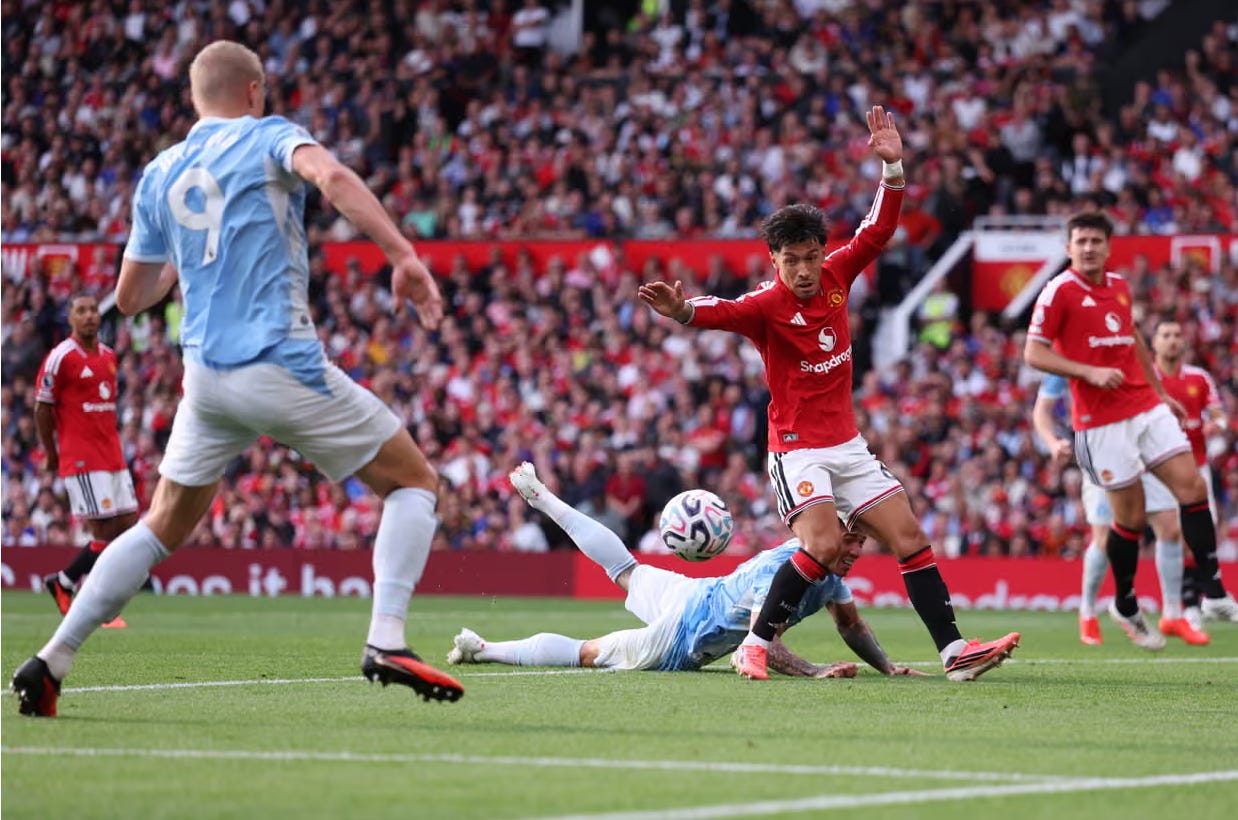
Manchester City had been playing with 10 men since Phil Foden was sent off in the 23rd minute when Erling Haaland appeared to give his side the lead in the 60th. The goal was initially ruled out for offside before VAR took a nice long and hearty look at it and decided that, actually, everything was fine. Haaland’s positioning wasn’t really the issue. Enzo Fernández was standing in an offside position in front of Lisandro Martínez and made an attempt at the ball, which forced Martínez to react before it eventually reached Haaland at the back post. Inexplicably, however, VAR decided Fernández hadn’t interfered with play.
Yeah, Manchester United didn’t like that.
“I think it was offside,” Martínez said afterward. “And what I can’t understand is the rules. He [Fernández] was there, I went to him. He was there, in front of me. So that’s why [Erling] Haaland was free at the back.”
Martínez then went a little further, which I can’t particularly blame him for. He pointed out that referees visit clubs before every season to explain these rules and then somehow arrive at decisions like this anyway. “It’s unacceptable,” he said. “Because it’s the best league in the world, you have the best teams in the world, the best players in the world, and now we have to go home with this injustice.”
Manchester United manager Michael Carrick wasn’t doing much better trying to understand the explanation.
“The explanation I got was he wasn’t interfering with play, so I just don’t get it,” Carrick said. “He’s thrown himself at the ball six yards from goal and pretty much nearly touched it.”
That’s the part I can’t get past either. Fernández is standing directly in front of Martínez and actively attempting to reach a ball traveling across the six-yard box. Martínez has to account for him because ignoring a player attempting to score from six yards away would generally be considered a poor defensive strategy. Yet somehow we’re supposed to believe Fernández’s presence had nothing to do with what happened behind him.
Bull crap.
Respectfully.
Carrick continued: “It’s worrying if that’s really how the game’s seen by those who are officiating it. I think we all understand what that rule means, and it’s pretty obvious, you know? It’s pretty obvious. I think it’s as obvious as it gets.”


And then came the plot twist.
A couple of hours after the match, Pro Ref (short for Professional Game Referees), the official governing body of football officials in England, acknowledged that United was right. The organization said VAR “did not recognise the likely impact” of Fernández’s position and should have recommended an on-field review, adding that it had contacted Manchester United to acknowledge what it deemed “an error of judgement.”
Wonderful.
The weird part about this game is that while United was screwed, it also didn’t deserve to win. City played with 10 men for more than an hour at Old Trafford, and United never really looked capable of taking advantage of it. There was plenty of possession, but very little of it seemed particularly threatening, and the fact that City was even in a position to score the decisive goal with a man down is an indictment of how poorly United responded to the red card.
So, Manchester United got screwed. It was also very, very bad. And in the end, Manchester is blue.