

This is a free excerpt from The Football Notebook. To read the full article, click the link below.
The Football Notebook: Red River’s Majesty, Manchester City’s Strange Win and the NFC East’s Diasterclass

Welcome to The Football Notebook, the weekly repository where I digest the football weekend that was while simultaneously racking my brain for answers about the existential problems of the universe.
As an adolescent child who was growing to love sports, Oklahoma-Texas was my entry point into the greatness that is college football. It was the unofficial kickoff to fall, the point on the calendar where North Texas finally begins shifting from “Man, is this heat unbearable?” to “Wow, what wonderful weather we’re having,” even if everyone knows another 93-degree day is probably waiting around the corner. Family, friends and loved ones would gather in front of the television to watch the Sooners and Longhorns, two programs that have roots running deep through my household and plenty of others across Oklahoma and Texas. Even when I didn’t have a rooting interest, I understood that this game mattered differently.
Some of my earliest college football memories are tied to it. I remember Colt McCoy and Sam Bradford in the hazy way you remember sports from childhood, where the details occasionally blur together but the feeling never really does. The memories sharpen as I get older: CeeDee Lamb making Texas defenders look helpless in space, Sam Ehlinger carrying the Longhorns through the Cotton Bowl, the stadium split perfectly in half while the State Fair spins around it. Even through a television screen, the whole thing feels alive.
The State Fair is not some convenient backdrop, either. It is part of the game itself. The Ferris wheel sits beyond the stadium, the smell of fried food practically comes through the television and tens of thousands of people spend several hours sitting next to people they would otherwise never willingly associate with because those people happened to wear the wrong shade of red. There are bigger stadiums in college football and louder crowds, but I’m not convinced there is another setting that feels so unmistakably like itself.
The football had stopped matching the surroundings in recent years, which was the frustrating part. For much of the 2010s, Oklahoma and Texas treated defense like an optional elective and everyone watching happily accepted the arrangement. The games became track meets where a two-score lead offered roughly the same amount of security as leaving your front door unlocked with a sign outside that says nobody is home. You would blink, somebody would score, and before you had finished complaining about what just happened, another quarterback was already jogging onto the field.
That version of Red River disappeared for a while. Oklahoma’s offense became remarkably allergic to scoring while its defense improved, which was a bizarre inversion of everything we had come to understand about the Sooners during the previous decade. Texas became the more complete operation, and the last two meetings played out accordingly. OU got battered, Texas celebrated, and one of the sport’s great annual traditions started feeling a little too predictable.
Most people expected some version of that again Saturday, and I was right there with them. Oklahoma entered the game with an offense that looked capable of turning a second-and-4 into a philosophical crisis, while Texas had the kind of defense that should have made life miserable. The Longhorns also had enough offensive talent to make the assignment fairly simple. Steve Sarkisian didn’t need to reinvent football. Arch Manning didn’t need to become Peyton and Eli combined into one super-quarterback. Texas just needed to score enough, protect the football and let its defense do the heavy lifting.
Two-thirds of that worked beautifully.
Texas’ defense did exactly what everyone expected, holding Oklahoma to 238 yards and making sustained offense feel like advanced calculus. The Sooners spent long stretches looking like a team trying to solve a Rubik’s Cube while wearing oven mitts, and Texas’ offense did enough to create the opportunities that should have been sufficient. The problem was that Manning kept handing Oklahoma oxygen.
His pick-six late in the third quarter was the first disaster. Manning rolled to his right, tried to create something that wasn’t there and threw the football like he was attempting a fadeaway jumper from the baseline, only the defender waiting underneath it happened to play for Oklahoma. It was the kind of interception where you know something has gone horribly wrong before the ball is even caught, and the return itself almost felt ceremonial.
To Manning’s credit, he answered with one of those throws that reminds everyone why NFL evaluators still stare at him like scientists inspecting a particularly interesting specimen. Texas came right back and scored, briefly restoring the feeling that the Longhorns would overcome the mistake and leave Dallas annoyed but victorious. That is the maddening part of watching Manning right now. The talent is not theoretical. You can watch him make a throw very few college quarterbacks can make and then, several possessions later, wonder whether somebody swapped him out with an evil twin.
The second interception came with the game tied at 24 and Texas trying to get into position for a winning field goal. This was supposed to be the moment where the Longhorns calmly finished the job, where Manning added another entry to the family scrapbook and the burnt orange half of the Cotton Bowl poured into the fairgrounds looking for something deep-fried to celebrate with. Instead, he gave the ball back to Oklahoma with less than 20 seconds remaining, and suddenly a game Texas had spent most of the day controlling belonged to everybody.
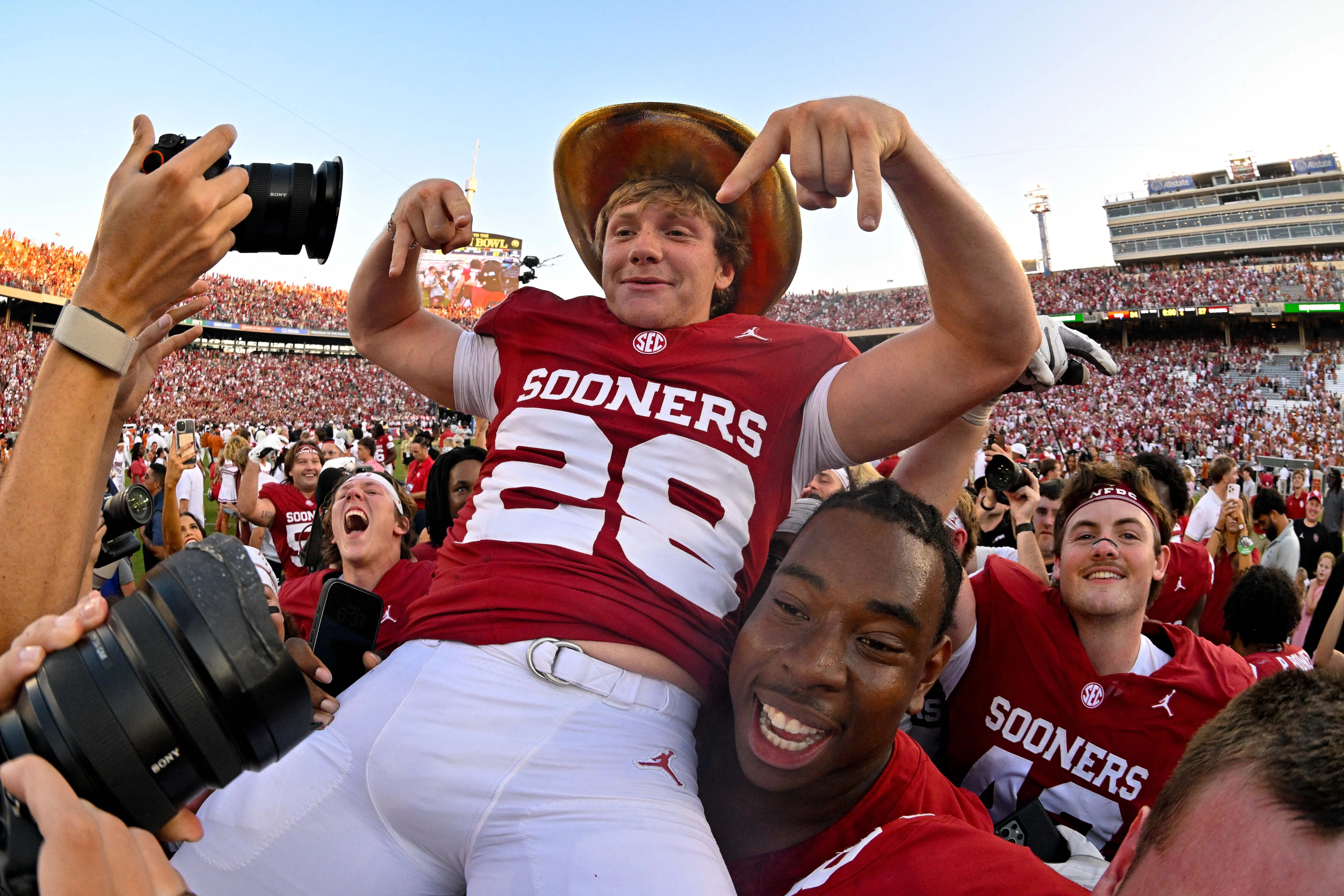
Oklahoma somehow found the necessary yardage to give kicker Tate Sandell a chance because a game this delightfully stupid was never going to end with somebody kneeling out the clock and trudging toward overtime. Sandell buried the field goal, prompting the crimson half of the Cotton Bowl to explode just as much as one’s bowels following a trip to the Texas State Fair. Meanwhile, the Texas side looked like somebody had just informed them that Bevo was being audited by the IRS.
It was everything I wanted Red River to be again, not because Texas lost or Oklahoma won — I couldn’t care less — but because the game finally felt unpredictable in the way this rivalry is supposed to feel. Football often doesn’t care what the box score suggests should’ve happened, and Red River has always been especially rude about reminding people of that.
In other words, logic is invited to this game, but it doesn’t receive voting rights. The better roster can lose. Red River takes every neat little argument we build during the week and occasionally lights it on fire somewhere near Big Tex. It’s beautiful.
There are plenty of wonderful rivalries in college football, and fans of Michigan-Ohio State, Alabama-Auburn and plenty of others have persuasive cases built around games that mean just as much to them. I respect all of those arguments and will happily ignore them, at least for now.
Texas-Oklahoma is the best college football game. I believed it when I was a kid watching from my living room, and Saturday reminded me why that opinion became lodged so deeply in my brain in the first place. Someday I want to sit inside the Cotton Bowl for it, surrounded by fried food, unreasonable adults and a stadium divided perfectly down the middle. Until then, I’ll keep watching every October and hoping the game continues to make absolutely no sense.