

Tuesday was election night in America, and while millions of people were watching television to discover who would control Congress, 13 other Americans were exercising their own democratic rights in a conference room somewhere, deciding the fate of the college football universe.
The results were, depending on your personal allegiances, either deeply encouraging or downright horrifying. An enormous SEC wave swept through the College Football Playoff rankings, lifting Alabama into the top five and giving several other conference members a renewed sense of purpose. UCLA, Notre Dame and BYU were among those left surveying the damage, wondering what they could’ve possibly done differently to earn the approval of their fellow Americans.
I’m not sure anybody would’ve predicted the magnitude of this SEC wave. It was a tremendous night for the conference, which somehow managed to place five teams inside the top 10 and 10 inside the top 25, despite the fact that its members have developed an unfortunate habit of beating each other to a pulp every Saturday.
There were some rather peculiar decisions along the way, and I’ve spent much of the past 24 hours attempting to understand them. I’ve consulted the numbers, examined the committee’s methodology and watched a considerable amount of media coverage featuring people who appeared even more confused than I was.
The committee might have a perfectly reasonable explanation for everything. I would love to hear it, because the explanations offered Tuesday night only made the whole thing more fascinating.
The SEC Wave Has Arrived
In my preseason SEC preview, I jokingly suggested that the conference’s new nine-game schedule would eventually produce a collection of three-loss teams demanding playoff consideration in November.
Well, we’re here. It’s November, the SEC has more representatives in the CFP rankings than any other conference and two of its three-loss teams are already among the nation’s top 25.
I’m not going to pretend the SEC isn’t good. I wrote extensively about the challenges of its nine-game schedule before the season began, and I’ve maintained that its depth is better than that of any other conference. The problem is that the committee’s treatment of the SEC appears substantially more generous than its treatment of everybody else.
Consider the representation in Tuesday’s rankings:
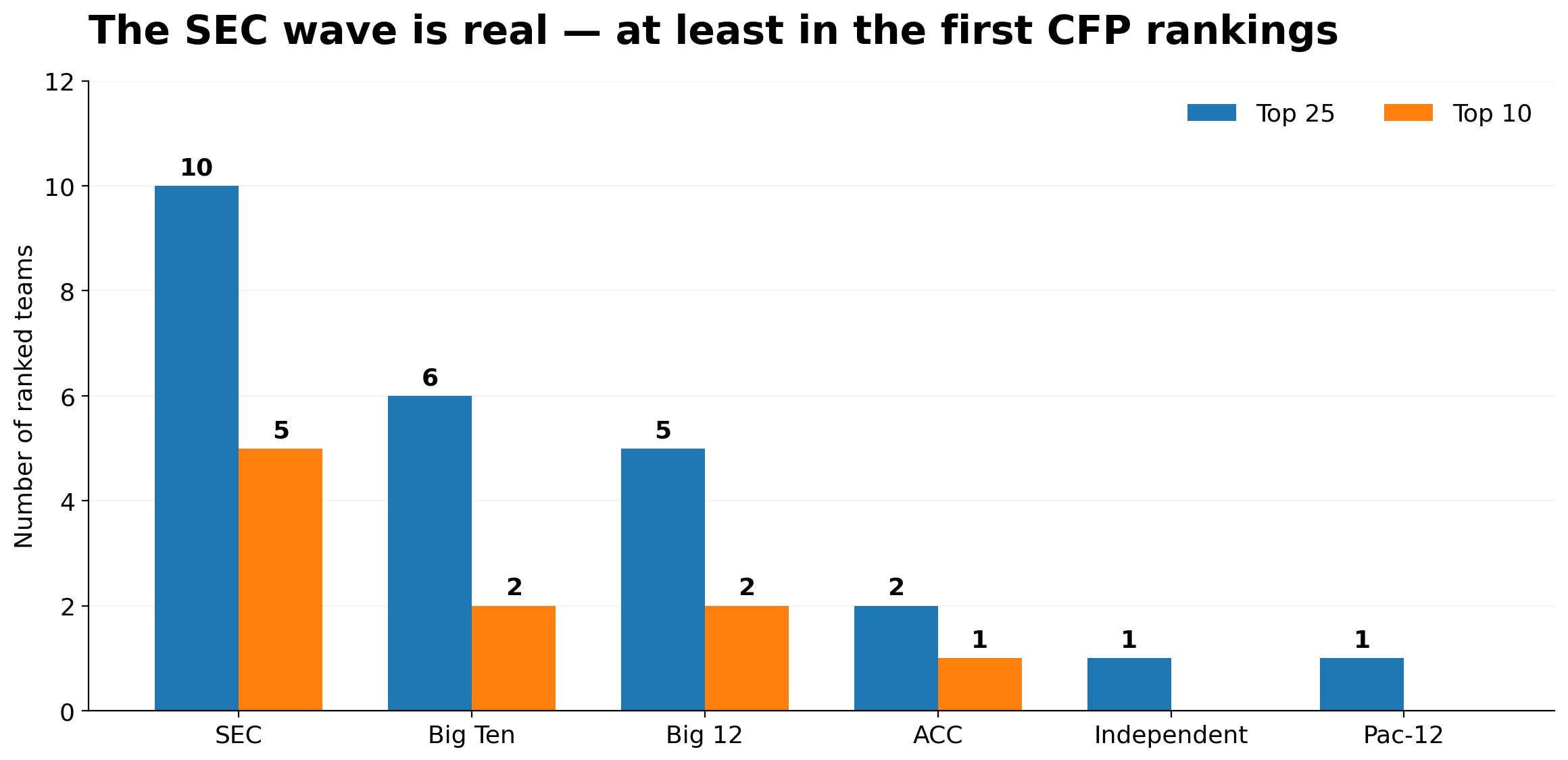
Five SEC teams occupy the top 10, including three with two losses: Alabama, Texas and Ole Miss. Meanwhile, undefeated UCLA is eighth, BYU is ninth despite beating Notre Dame, and Notre Dame itself is 11th despite sitting fourth in the AP poll.
The committee’s rankings are hardly a carbon copy of the national consensus. Alabama jumped from ninth in the AP poll to fifth in the CFP rankings, Texas moved from 10th to seventh and Ole Miss climbed into the top 10. Notre Dame, on the other hand, fell seven positions, while UCLA dropped three.
I’m not suggesting those movements are necessarily wrong. The committee exists precisely because college football wants somebody to conduct an independent evaluation, rather than simply reproducing whatever the AP voters decided Sunday morning.
But if the justification for placing two-loss SEC teams above undefeated opponents is strength of schedule, then I’d expect that philosophy to apply with some consistency throughout the rankings.
It doesn’t.
Alabama’s Remarkable Election Night
Alabama is the committee’s fifth-best team in college football, an extraordinary assessment for a program that has lost two of its past three games.
The Crimson Tide are 6-2, with losses against Georgia and Tennessee. The former was a competitive 20-17 defeat against the committee’s second-ranked team, while the latter was a 26-10 loss in Knoxville that wasn’t particularly competitive.
Alabama’s most impressive result came against Kentucky on Sept. 12, when the Tide overcame a four-point halftime deficit to win 45-17. They outscored the Wildcats 32-0 in the second half, held them to 209 total yards and allowed just one third-down conversion in 14 opportunities. That’s a tremendous victory, and Kentucky’s subsequent improvement has only made it more impressive. The Wildcats are 7-1 and ranked sixth, which makes Alabama’s 28-point road win one of the strongest results any team has produced this season.
There is also Alabama’s 49-18 victory over South Carolina, another team the committee apparently admires enough to rank 21st despite three defeats.
So the argument for Alabama is reasonably straightforward: the Crimson Tide have two wins over currently ranked opponents, including an absolute demolition of the team immediately behind them.
The problem is Tennessee.
The Volunteers are 6-2, just like Alabama, and defeated the Crimson Tide by 16 points. They have two three-point losses against Texas and South Carolina, both of which the committee also ranked.
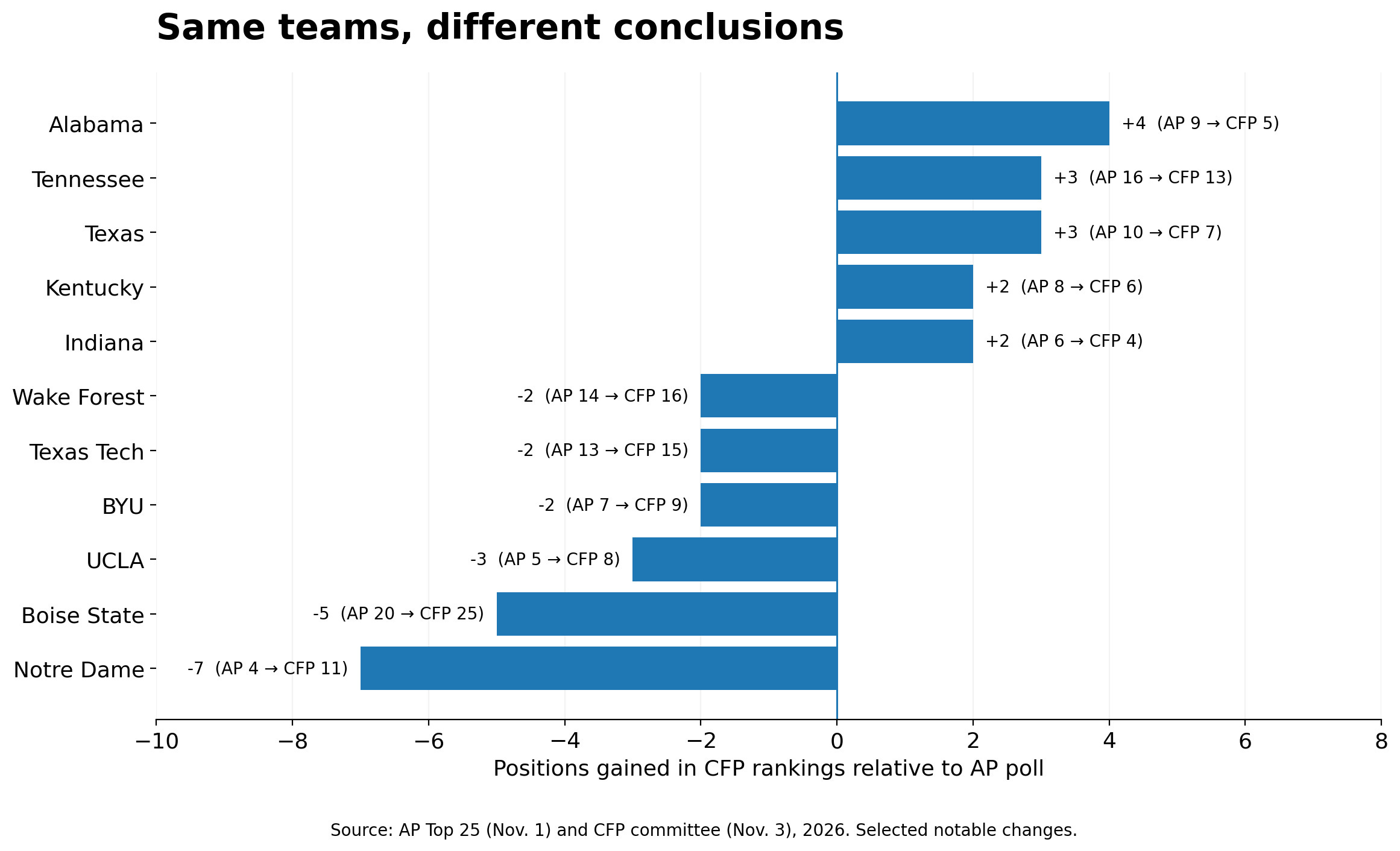
Yet Tennessee finds itself 13th, eight positions behind Alabama, which means the committee believes the team that lost their head-to-head meeting by more than two touchdowns deserves to be substantially higher than the winner. ESPN’s Football Power Index provides some support for that assessment. Alabama ranks sixth in FPI, while Tennessee is 14th, and the Tide’s collection of quality wins is stronger.
But Alabama’s predictive strength isn’t an adequate explanation for everything else. Notre Dame ranks first in FPI and finds itself 11th in the CFP rankings, while Ohio State is second in FPI and 12th according to the committee. Kentucky, meanwhile, ranks 26th in FPI and sixth in the CFP. UCLA is 28th in FPI and eighth in the CFP.
In other words, the committee appears perfectly comfortable rewarding a strong résumé when evaluating Kentucky, predictive strength when evaluating Alabama and actual wins when evaluating Miami.
I suppose that’s one way to approach the exercise, although it makes predicting the rankings roughly as straightforward as predicting what will happen next on The Traitors.
The Committee’s Wonderful Little Clusters
There’s an explanation for some of this weirdness, and it involves the committee’s voting process, something that’s been a subject of controversy for a while now.
According to the official CFP selection protocol, members begin by identifying a pool of six teams before ranking them in smaller groups. The process continues through seven rounds of voting until all 25 positions have been filled.
This sounds OK until you consider what happens when two teams that played each other aren’t evaluated in the same group.
Take Ohio State, for instance. The Buckeyes defeated Indiana 19-15 in Bloomington on Oct. 17, but the Hoosiers are ranked fourth and Ohio State is 12th. Committee chairman and Arkansas athletic director Hunter Yurachek acknowledged Tuesday that the committee never directly compared the two programs because they weren’t in the same group.
Alabama and Kentucky, meanwhile, were compared against each other, and Alabama’s head-to-head victory helped determine their order.
So Alabama gets credit for beating Kentucky because the two programs happened to be evaluated together, while Ohio State’s victory over Indiana receives no equivalent direct comparison because the teams were too far apart in the committee’s preliminary assessment.
Wonderful. We’ve created a ranking system where the importance of an actual football result depends, at least partly, on which group of teams happens to appear on somebody’s ballot.
To be fair, Ohio State’s loss against USC was ugly, and quarterback Julian Sayin’s absence creates legitimate questions about the Buckeyes’ immediate future. Indiana’s superior record also deserves consideration, though the Hoosiers have continually had to survive scares, this past weekend’s overtime adventure against Minnesota being the latest chapter in that story.
But Ohio State has the better predictive profile. It beat Indiana on the road. And if we’re going to reward Alabama so heavily for defeating Kentucky, I would appreciate somebody explaining why the same logic isn’t being applied with comparable enthusiasm elsewhere.
The committee says it evaluates each team’s full body of work, and I’m willing to believe that’s what its members are attempting to do. I just wish the results reflected a more coherent understanding of what constitutes an impressive body of work.
The Three-Loss Club Is Back in Business
Tuesday was also a wonderful evening for South Carolina, Oregon and Florida, three programs that had probably begun making alternative holiday arrangements before discovering that the committee still considers them among the country’s 25 best teams.
South Carolina is 21st at 5-3, Oregon is 23rd at 5-3 and Florida is 24th at 5-3. All three sit above schools like New Mexico or Northwestern, the former of which is 7-1 and ranked 22nd in the AP poll but received no invitation to the committee’s exclusive little gathering.
There are legitimate arguments for those placements. Oregon has played an extremely difficult schedule, Florida owns a victory over Texas and South Carolina has defeated Tennessee. Their records don’t necessarily reflect their underlying quality, which is precisely why predictive metrics and schedule adjustments exist.
But the committee’s decision creates an uncomfortable incentive for teams outside the major conferences. Apparently, seven wins and one loss aren’t necessarily worth as much as five victories and three defeats if the latter come against opponents the committee already considers impressive.
And while that might be mathematically defensible, there’s also a possibility of creating a rather convenient feedback loop. SEC teams receive credit for beating other SEC teams that are ranked because they’ve beaten still more SEC teams, and eventually everybody receives a participation certificate for surviving the conference schedule.
I’m exaggerating, obviously. But only a little.
The new strength-of-conference enhancement was designed to provide more context about schedule difficulty, and it appears to have arrived at exactly the right moment for the SEC.
The committee has made clear that losing doesn’t necessarily disqualify a team if the opposition is sufficiently strong. Fair enough. I would simply like to know where that forgiveness ends, because the boundary seems to move depending on which team is being evaluated.
The Official Corner Poll (Finally)
Enough of the committee’s nonsense. It’s time to introduce an entirely different variety of nonsense.
